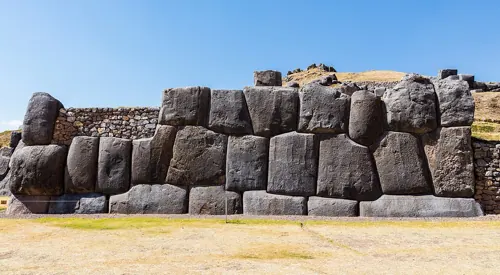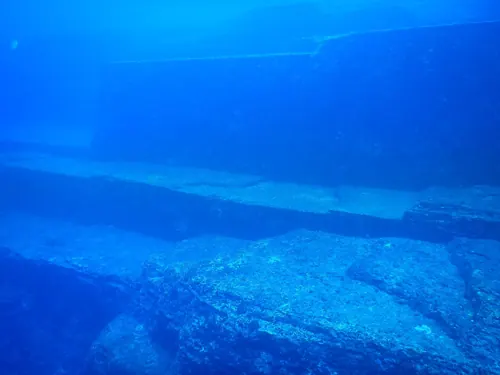
Off Pohnpei, the Saudeleur dynasty raised 92 artificial islets on a lagoon grid: walls of naturally prismatic basalt columns stacked like timber, some weighing 50 tonnes or more, in an estimated 750,000 tonnes of moved basalt and coral. Canals served as streets; royal compounds, ritual centres and the tomb islet of Nandauwas rose straight from the water. Pohnpeian tradition says the sorcerer-brothers Olisihpa and Olosohpa flew the stones into place. How they were actually ferried across the reef remains unsolved.
See Nan Madol on the globe
Opens with the Ley Lines lens on, so you can see what it connects to.
Notable facts
- Estimated 750,000 tonnes of basalt and coral moved — with a total island population that likely never exceeded 30,000.
- The basalt is columnar (hexagonal) — nature supplying ready-made megalithic 'logs'.
- It was abandoned before European contact; locals long avoided it after dark.
Through the theories
How each theory reads Nan Madol. Follow a theory to see its verdict and every other site it claims.
Ley LinesMostly chance
Its lagoon-grid plan is read by some as oriented to reef passes and star-compass bearings used in Micronesian navigation.
Lost WorldRejected by mainstream
Pohnpeian legend of a drowned twin city, Kahnimweiso, keeps sunken-civilisation readings of the basalt canals alive.
Earth GridNo measurable evidence
A staple of lost-continent literature (as capital of 'Mu'); the levitation legend is cited alongside similar tales at Uxmal and Stonehenge.