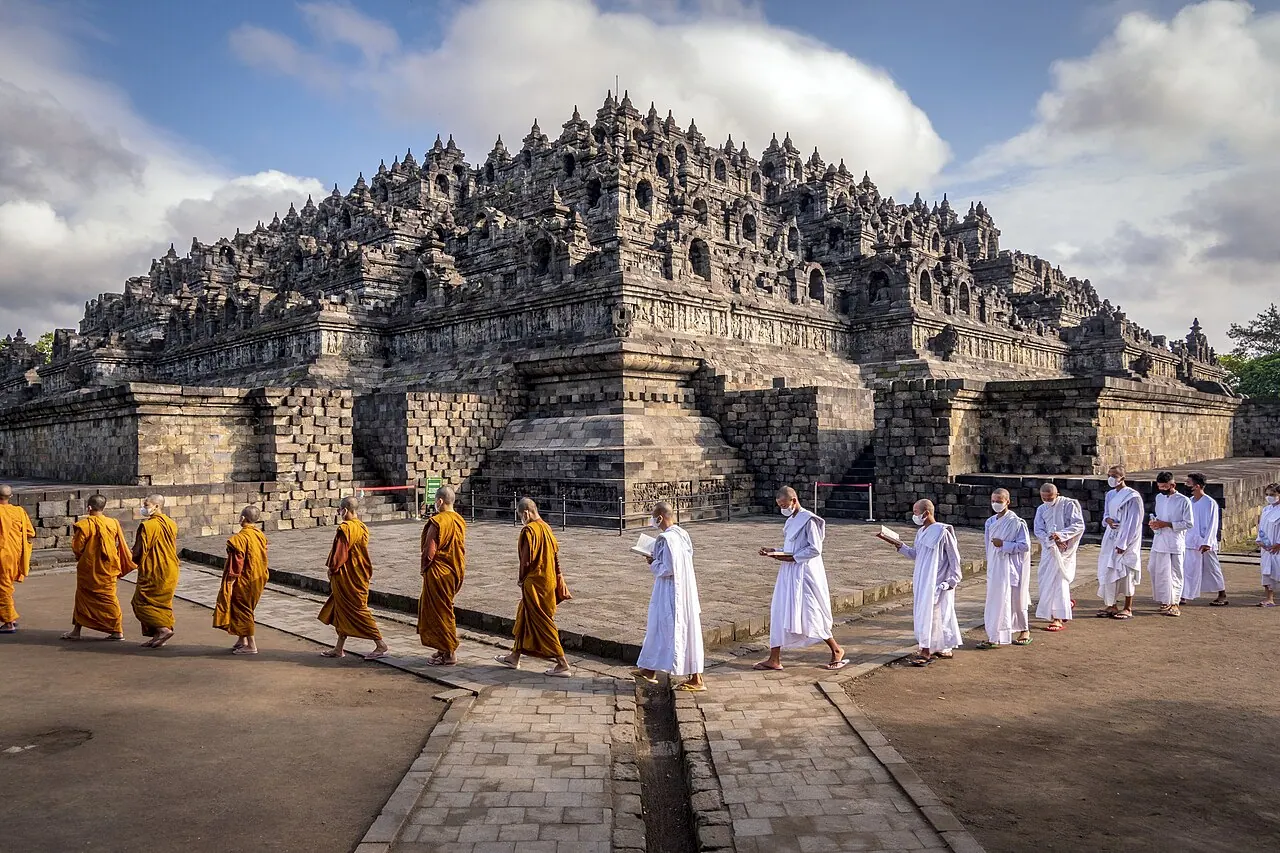
The world's largest Buddhist monument is a walkable mandala: pilgrims circle ten terraces — six square, three round, one crowning stupa — climbing from the realm of desire through the realm of forms to formlessness, past 2,672 relief panels and 504 Buddhas. Seen from above it is a tantric diagram; in section it is a cosmic mountain over a buried 'hidden foot' of karmic reliefs. It was abandoned — after volcanic eruptions, the shift of power to East Java or the spread of Islam, scholars debate which — and slept under ash and jungle for centuries.
See Borobudur on the globe
Opens with the Sky Alignments lens on, so you can see what it connects to.
Notable facts
- The narrative reliefs run ~3 km — one of the most extensive sequences of Buddhist narrative relief anywhere.
- 72 latticed stupas on the round terraces each hold a Buddha, half-seen — form dissolving into emptiness.
- Built without mortar from two million andesite blocks, on a fluid drainage core.
Through the theories
How each theory reads Borobudur. Follow a theory to see its verdict and every other site it claims.
Sky AlignmentsEstablished science
Gunadharma legend aside, studies suggest stupa sightlines tracked the sun and possibly Canopus.
Axis MundiEstablished anthropology
A walkable Mount Meru: the cosmic axis rendered as ten terraces of ascent from desire to formlessness.
Sacred GeometryA spectrum
The clearest built mandala on Earth — its plan is literally the meditation diagram it teaches.
Earth GridNo measurable evidence
Sits on a claimed straight line with Mount Merapi and older temples; volcano alignments are taken as intentional axis mundi placement.