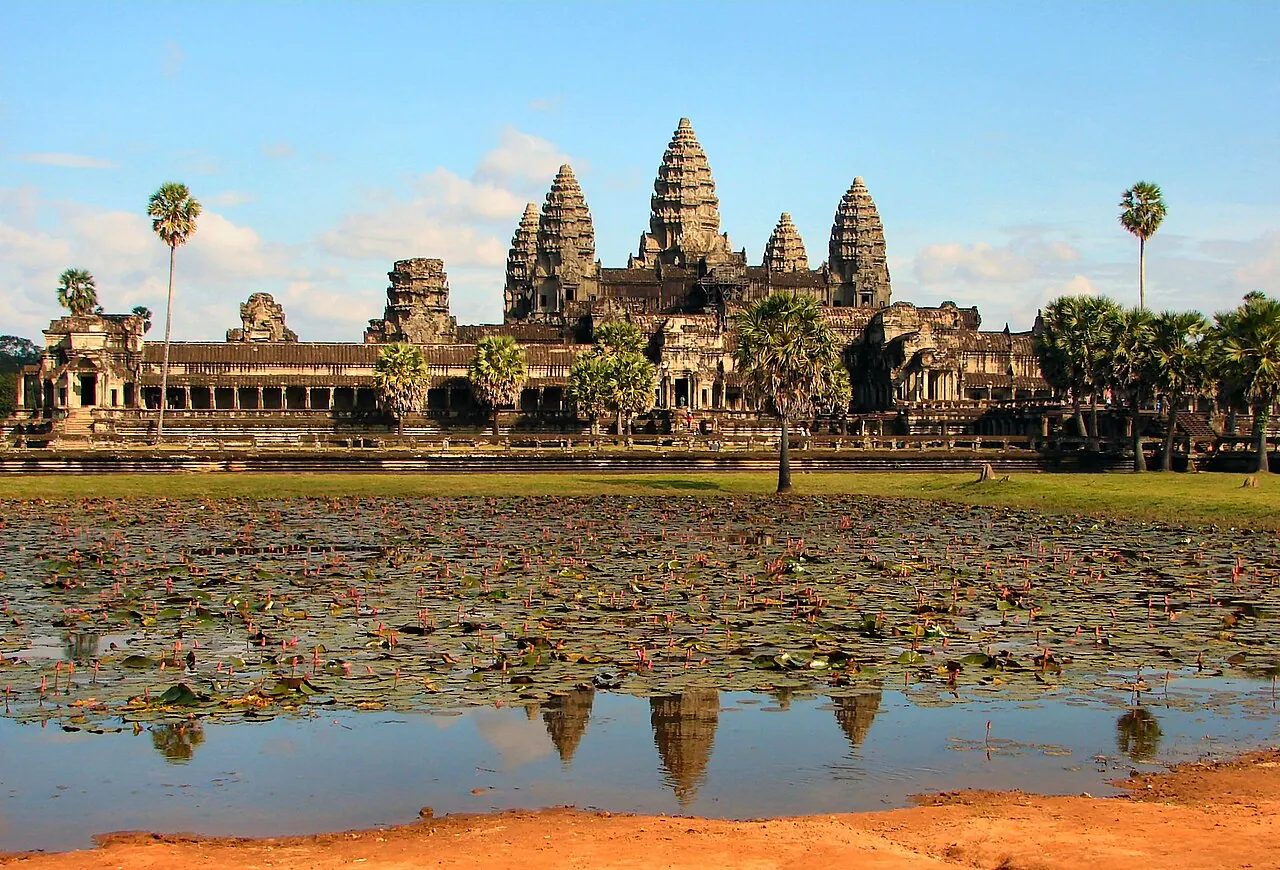
Suryavarman II's temple-mountain is a scale model of Hindu cosmology: five peaks for Meru's summits, galleries for the world-mountain's rings, a 190-metre moat for the cosmic ocean. Its roughly 1,000 m² of gallery bas-reliefs include the Churning of the Sea of Milk, 49 metres of gods and demons tug-of-warring creation itself. At spring equinox the sun rises precisely over the central tower as seen from the western causeway. Eleanor Mannikka's analysis found its dimensions encode Hindu cosmic time cycles — the yugas — in units of the Khmer cubit.
See Angkor Wat on the globe
Opens with the Sky Alignments lens on, so you can see what it connects to.
Notable facts
- The moat's engineering has stabilised the water table beneath the temple for 900 years.
- Mannikka: the causeway's axial lengths in cubits match the durations of the four yugas (1,728 / 1,296 / 864 / 432).
- Unusually, it faces west — toward Vishnu, sunset and, perhaps, the funerary function of its king.
Through the theories
How each theory reads Angkor Wat. Follow a theory to see its verdict and every other site it claims.
Sky AlignmentsEstablished science
Equinox sunrise crowns the central tower; solstice sightlines link outlying temples like Phnom Bakheng.
Axis MundiEstablished anthropology
Five towers model Mount Meru's peaks — an empire physically arranged around the world-axis.
Sacred GeometryA spectrum
Mannikka's cubit analysis is sacred number made architecture — the strongest modern academic case for encoded cosmic measure.
Ley LinesMostly chance
Eastern anchor of Alison's great circle through Giza and Easter Island.
Lost WorldRejected by mainstream
Hancock aligned Angkor's temples to the constellation Draco as it stood in 10,500 BCE — the same 'first time' epoch he reads at Giza.
Earth GridNo measurable evidence
Graham Hancock's 'Heaven's Mirror' claims Angkor sits 72° of longitude east of Giza — a precessional number; critics note the actual figure is ~72.7°.