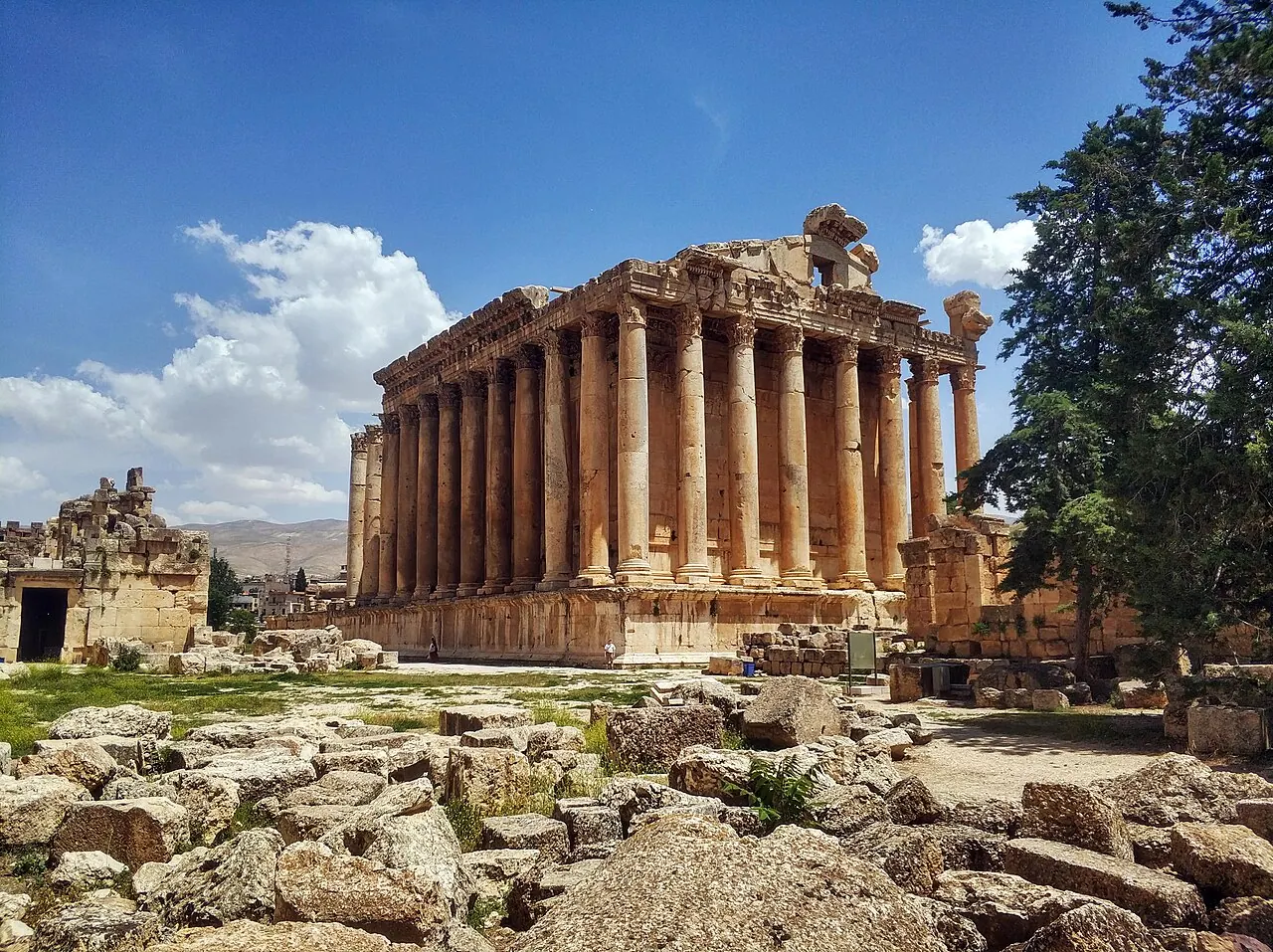
The Roman temple of Jupiter Heliopolitanus is itself colossal — its 54 columns were the largest in the empire — but the podium beneath it contains the trilithon: three limestone megaliths of roughly 800 tonnes apiece, raised 6 metres up and fitted seamlessly. In the quarry 800 metres away lie even larger blocks, including one of ~1,650 tonnes, the heaviest ever cut. Mainstream archaeology attributes the podium to Roman engineering; alternative writers argue the platform is far older, a pre-Roman 'landing platform' or antediluvian foundation.
See Baalbek on the globe
Opens with the Ley Lines lens on, so you can see what it connects to.
Notable facts
- The 'Stone of the Pregnant Woman' (~1,000 t) and a ~1,650 t neighbour still lie in the quarry.
- German-Lebanese excavations (2014) uncovered a ~1,650 t block beneath the Stone of the Pregnant Woman — cut, then perhaps abandoned because of a flaw in the stone.
- The temple complex was among the largest religious buildings of the entire Roman world.
Through the theories
How each theory reads Baalbek. Follow a theory to see its verdict and every other site it claims.
Ley LinesMostly chance
Sits at the Bekaa valley's watershed on routes linking Egyptian and Mesopotamian sacred geographies.
Lost WorldRejected by mainstream
The trilithon is claimed as the survival of a forgotten age, with the Roman temple merely perched on top.
Earth GridNo measurable evidence
Exhibit A of 'impossible masonry' literature; Sitchin made it a spaceport, Hancock a relic of a lost civilisation. Roman crane mathematics — multiple capstans and lewis holes — remains the sober answer.
AstronautsNo physical evidence
Sitchin cast the trilithon as a landing platform for Anunnaki craft — the largest stones on Earth explained by the largest leap in logic.