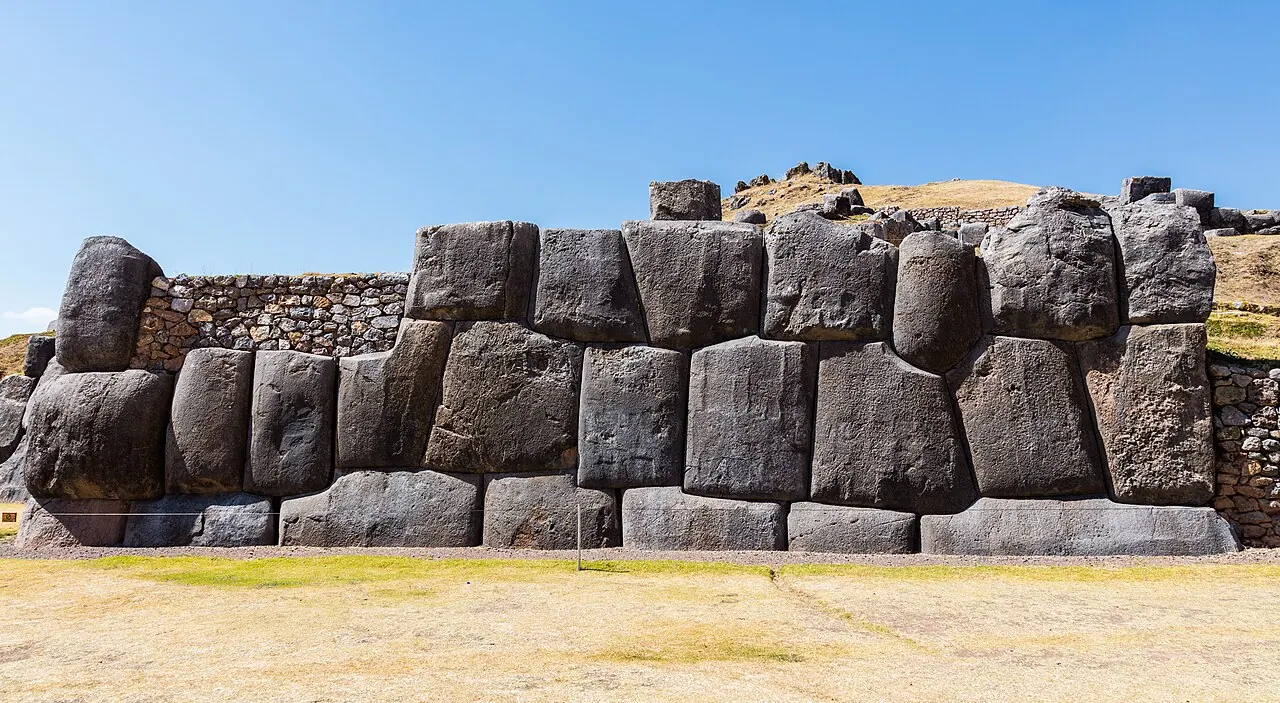
Above Cusco — the 'navel' of the Inca world — three tiers of cyclopean zigzag walls run for 400 metres. The largest block is estimated at over 120 tonnes, carved with rounded, almost pillow-like faces and interlocked in three dimensions without mortar. Spanish chroniclers, watching stones they could not explain, decided demons had built it. How the blocks were moved and dressed with bronze-age tools remains genuinely contested.
See Sacsayhuamán on the globe
Opens with the Axis Mundi lens on, so you can see what it connects to.
Notable facts
- The zigzag plan may represent the teeth of a lightning bolt or the head of a puma whose body was the city of Cusco.
- Many blocks are joined by complex inner keying invisible from outside.
- Vitrified (heat-glazed) surfaces reported on some stones remain unexplained and disputed.
Through the theories
How each theory reads Sacsayhuamán. Follow a theory to see its verdict and every other site it claims.
Axis MundiEstablished anthropology
Cusco means 'navel' in Quechua — the city where the four quarters of the Inca world met, with Sacsayhuamán as its crown.
Sacred GeometryA spectrum
Interlocking polygonal masonry as earthquake engineering: geometry used as structural intelligence.
Ley LinesMostly chance
A station on the Cusco ceque radial system and near the Alison great circle.
Lost WorldRejected by mainstream
Alternative chronologies read the lower cyclopean courses as vastly older than the Inca, who are cast as mere inheritors and repairers.
Earth GridNo measurable evidence
Cited in 'geopolymer' and 'ancient high technology' literature — claims the stones were softened or cast in place.