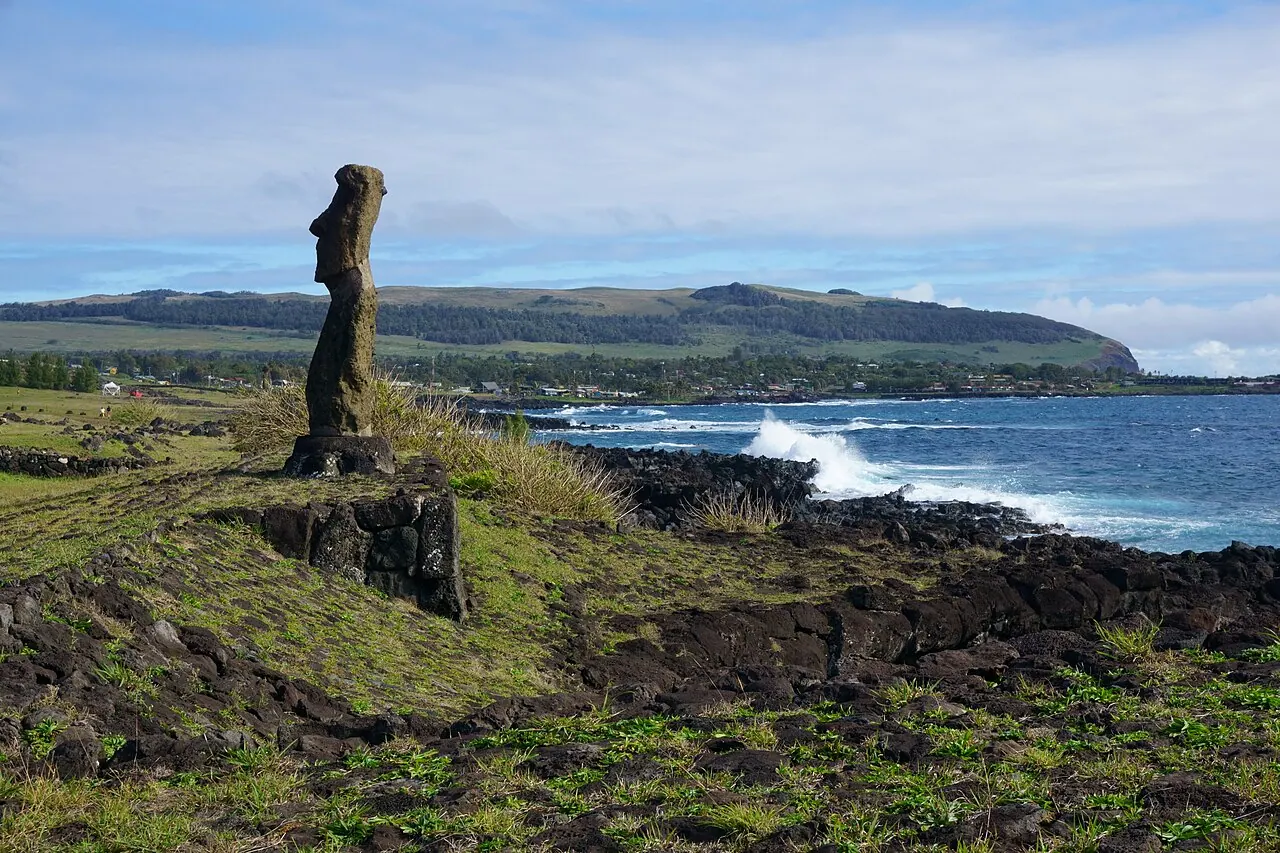
Two thousand kilometres from the nearest inhabited land, the Rapa Nui carved 900+ moai from volcanic tuff, the heaviest erected some 86 tonnes, and 'walked' them kilometres to coastal platforms (ahu). Oral tradition says the statues walked themselves; experiments show teams with ropes can indeed rock an upright moai forward. The island's largest ahu, Ahu Tongariki, holds fifteen figures in a line against the Pacific.
See Rapa Nui on the globe
Opens with the Sky Alignments lens on, so you can see what it connects to.
Notable facts
- The unfinished 'El Gigante' in the quarry would have stood 21 m and weighed ~180 tonnes.
- Most moai face inland, watching over their communities — not out to sea.
- Rongorongo, the island's undeciphered script, may be one of the very few independently invented writing systems — though some scholars think it was inspired by the Spanish visit of 1770.
Through the theories
How each theory reads Rapa Nui. Follow a theory to see its verdict and every other site it claims.
Sky AlignmentsEstablished science
Ahu Tongariki's moai face the June (winter) solstice sunset; several ahu encode solstice/equinox lines.
Axis MundiEstablished anthropology
The island's own name for itself: Te Pito o Te Henua — the navel of the world.
Ley LinesMostly chance
The Pacific anchor of Alison's great-circle alignment — almost exactly antipodal to sites like Mohenjo-daro's latitude band.
Lost WorldRejected by mainstream
Undeciphered script and colossal statues on the world's loneliest island read, to enthusiasts, like the last outpost of a drowned Pacific homeland.
Earth GridNo measurable evidence
Named by Ivan Sanderson's followers as near a 'vile vortex' node of the icosahedral earth grid.
AstronautsNo physical evidence
Von Däniken imagined stranded visitors carving the moai while they waited for rescue.