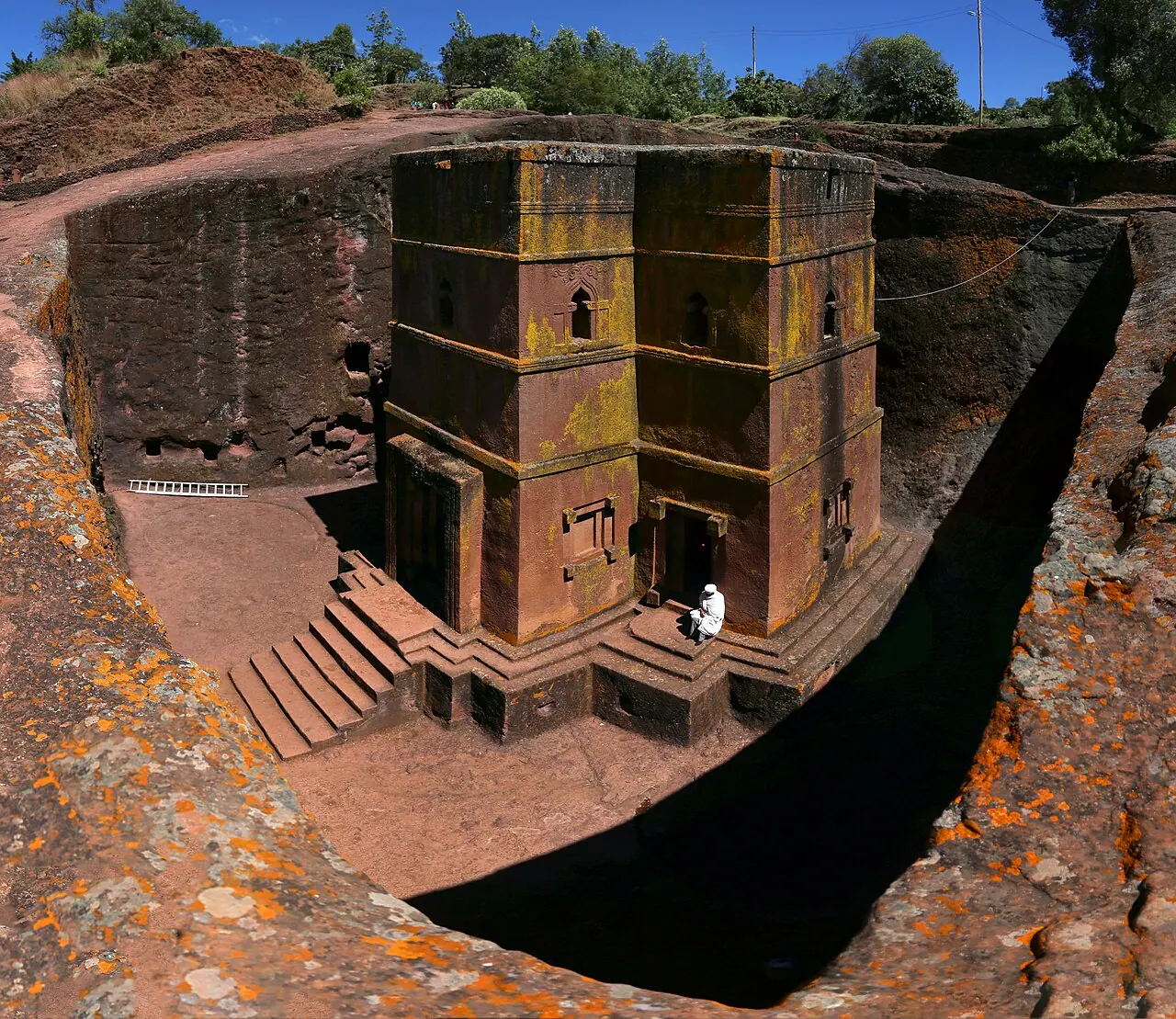
King Lalibela, tradition holds, was commanded in a vision to carve a new Jerusalem after Saladin took the old one. His masons cut eleven churches down into the red volcanic rock — four freed entirely from the bedrock, inside and out, drainage and all, the rest still joined to the cliff — probably over several building phases. Bete Giyorgis, the cross-shaped church of St George, is cut 12 metres deep into the plateau. The complex maps Jerusalem: its stream is named the Jordan, its mound Calvary.
See Lalibela on the globe
Opens with the Sacred Geometry lens on, so you can see what it connects to.
Notable facts
- Four of the eleven churches are fully free-standing monoliths; the other seven still share a wall with the rock — architecture as sculpture at full scale.
- Legend: men carved by day, angels continued by night at double speed.
- Still in continuous liturgical use by the Ethiopian Orthodox Church after 800 years.
Through the theories
How each theory reads Lalibela. Follow a theory to see its verdict and every other site it claims.
Sacred GeometryA spectrum
Bete Giyorgis's perfect Greek cross, cut freehand into a pit, is a tour de force of subtractive geometry.
Ley LinesMostly chance
The deliberate mapping of Jerusalem's sacred topography onto Ethiopian ground is 'transferred sacred geography' — the same instinct the line-hunters chase.