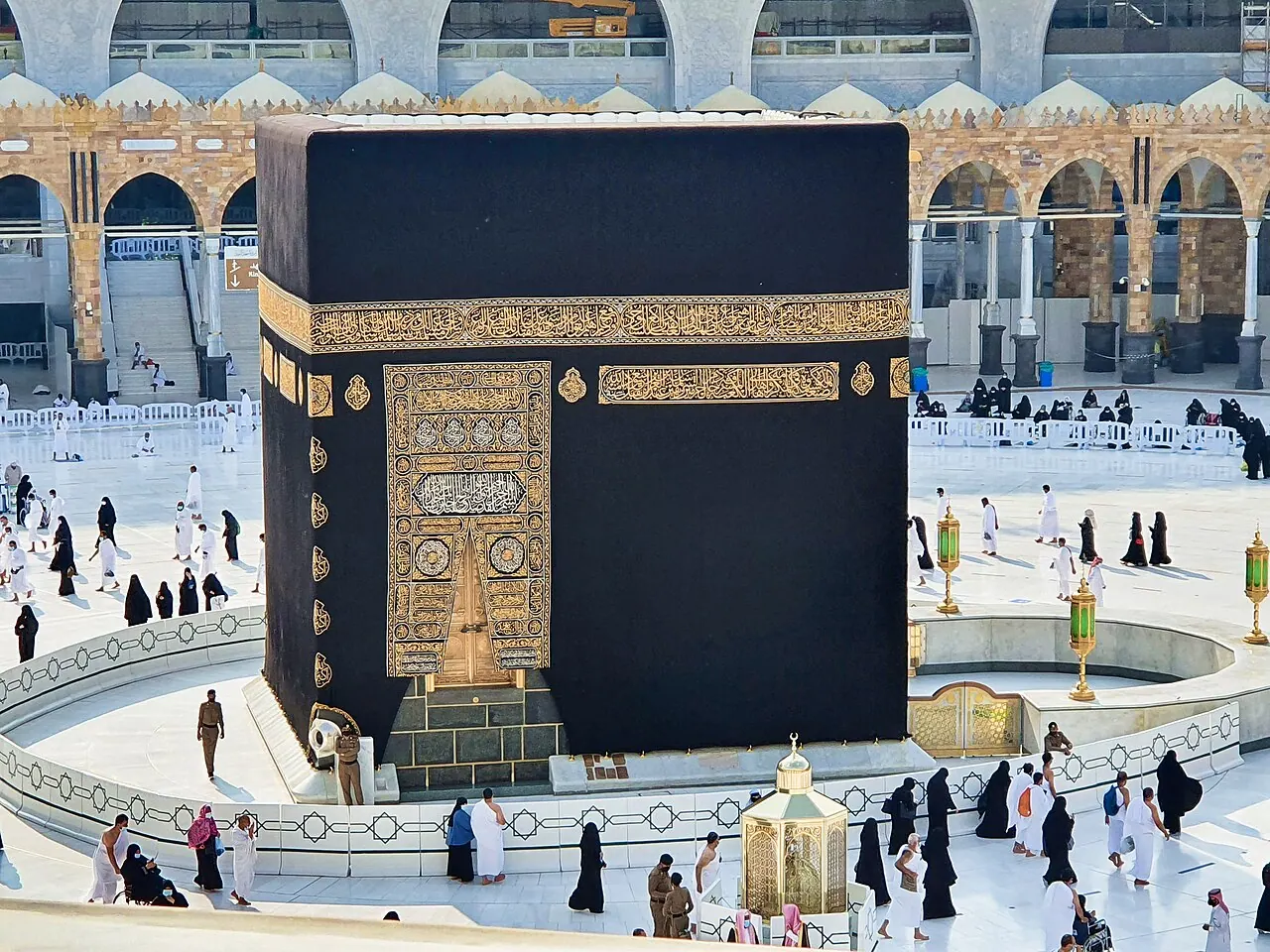
The Kaaba ('cube') predates Islam as a sanctuary; Muslim tradition holds it was built by Abraham and Ishmael on foundations from Adam. Set into its eastern corner is the Black Stone, in tradition fallen from heaven — possibly a meteorite, never scientifically tested. Every mosque on Earth, and every praying Muslim, orients toward this one building: the qibla makes it the focus of the largest orientation system in human history, and the tawaf's seven counter-clockwise circuits one of humanity's oldest continuous rituals.
See The Kaaba, Mecca on the globe
Opens with the Sky Alignments lens on, so you can see what it connects to.
Notable facts
- Qibla determination drove centuries of Islamic advances in spherical geometry and astronomy.
- The Black Stone was venerated long before Islam; its origin (meteorite, impact glass, basalt) remains untested.
- The Kaaba's corners roughly face the cardinal directions.
Through the theories
How each theory reads The Kaaba, Mecca. Follow a theory to see its verdict and every other site it claims.
Sky AlignmentsEstablished science
The Kaaba's minor axis points toward the summer solstice sunrise; its major axis toward the rising of Canopus.
Axis MundiEstablished anthropology
The Kaaba sits, tradition says, directly beneath the heavenly house the angels circle — the axis of a planetary geometry of prayer.
Sacred GeometryA spectrum
The global qibla network is a real, functioning planetary geometry — millions of great-circle bearings converging on one point.