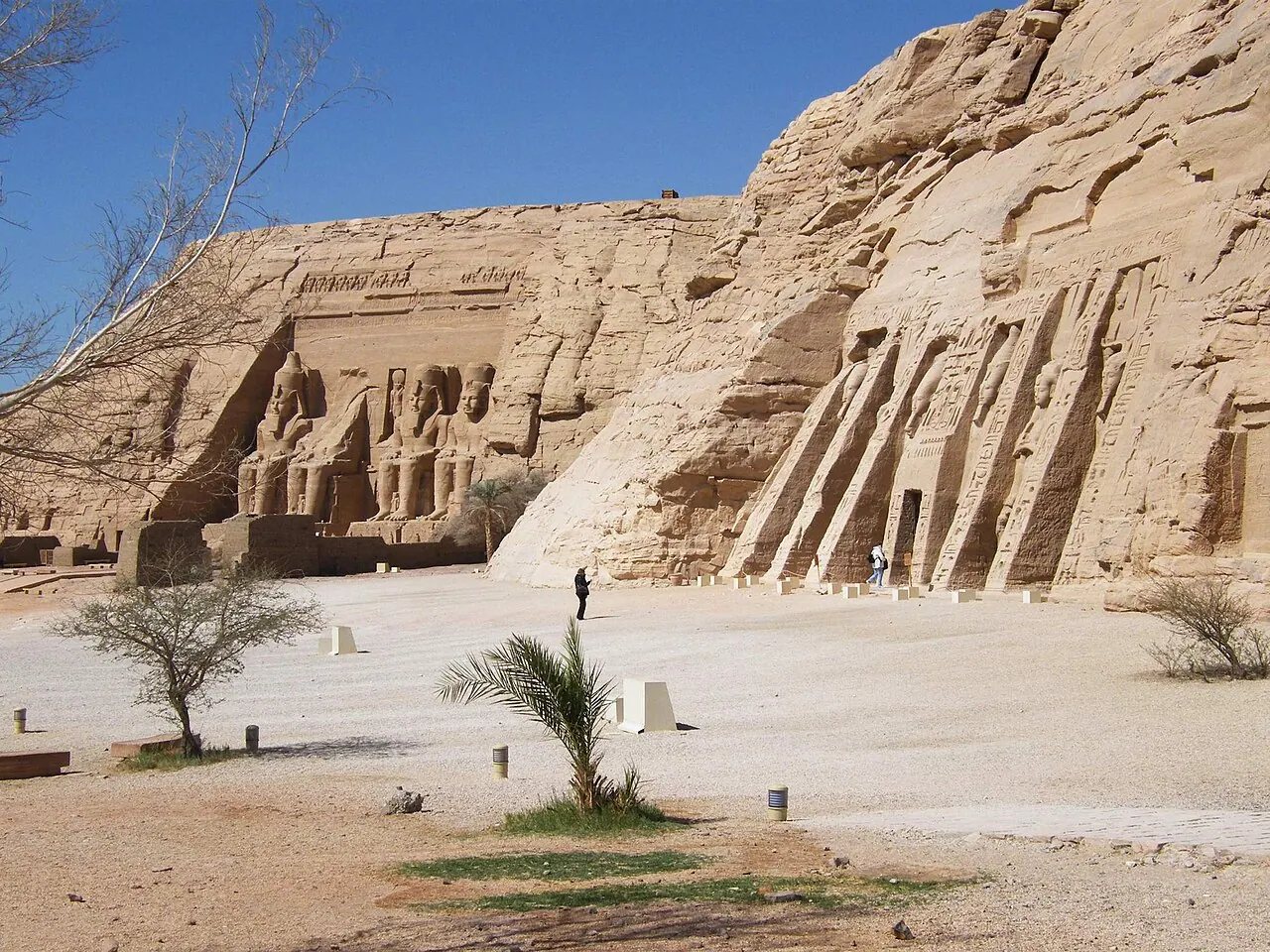
Ramesses II cut his great temple into a Nubian cliff so that on two dates — around 22 February and 22 October, popularly (though without direct evidence) tied to his birthday and coronation — the rising sun penetrates the full depth of the sanctuary and illuminates the statues of Amun-Ra, Ra-Horakhty and the deified Ramesses, while Ptah, god of the underworld, remains in shadow. In the 1960s the entire temple was sawn into 807 blocks and lifted 65 metres to escape the rising waters of Lake Nasser — shifting the solar event by one day.
See Abu Simbel on the globe
Opens with the Sky Alignments lens on, so you can see what it connects to.
Notable facts
- The four seated colossi of the facade are 20 metres tall, carved in situ.
- The UNESCO relocation (1964–68) remains one of the greatest feats of archaeological engineering.
- Ptah, alone of the four inner statues, is never touched by the sun.
Through the theories
How each theory reads Abu Simbel. Follow a theory to see its verdict and every other site it claims.
Sky AlignmentsEstablished science
The twice-yearly solar penetration is engineered narrative: light as theology, drama and dynastic propaganda at once.