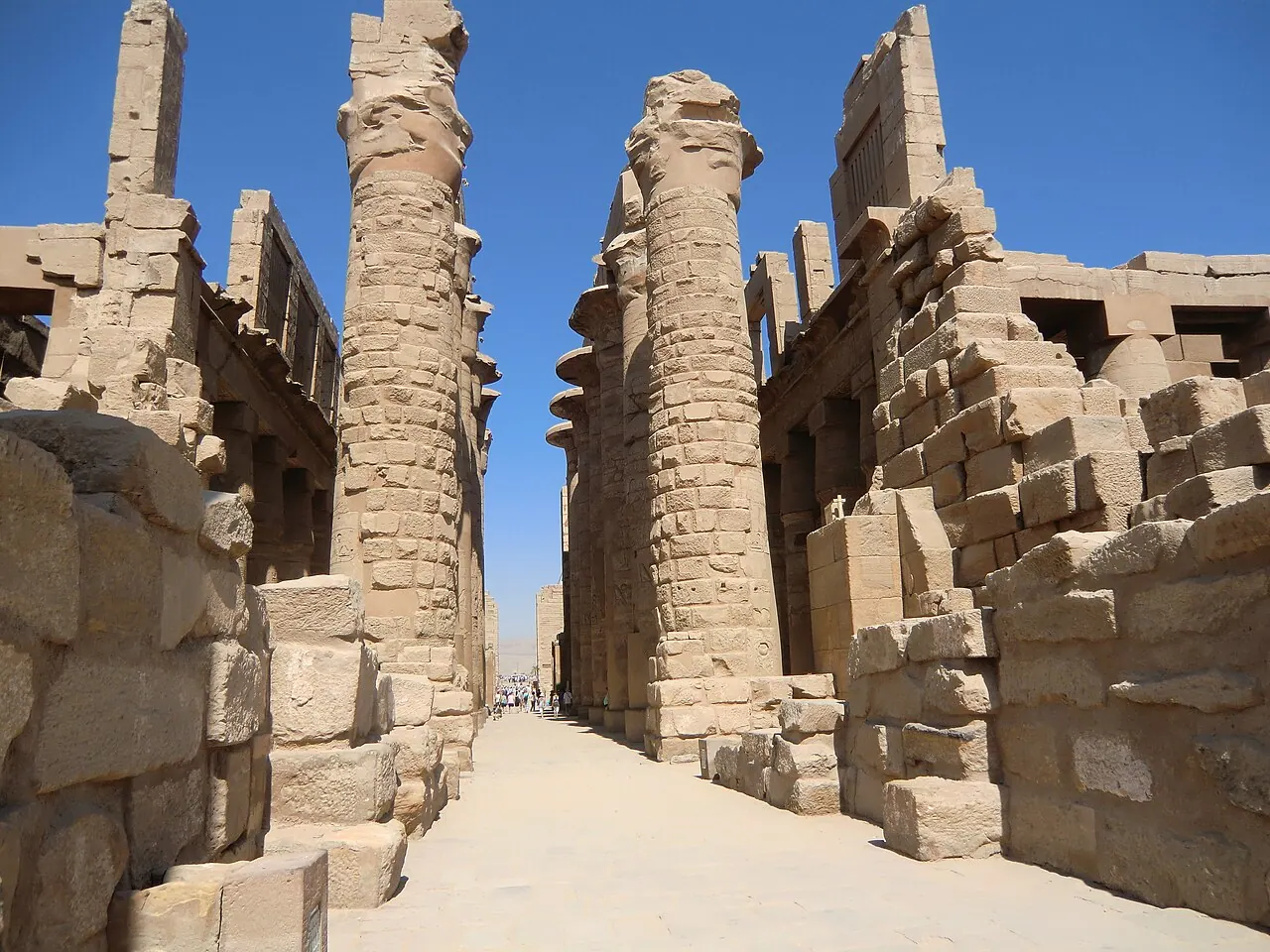
Built and rebuilt over two thousand years, Karnak's precinct of Amun-Ra alone covers some 25 hectares. The Great Hypostyle Hall's 134 columns — the central twelve 21 metres tall — held up a stone sky painted with stars. Its main axis aligns to the winter solstice sunrise over the eastern horizon. Norman Lockyer's 1894 'Dawn of Astronomy', the book that effectively founded archaeoastronomy, first measured it, though he read it the other way, as a midsummer-sunset alignment.
See Karnak Temple on the globe
Opens with the Sky Alignments lens on, so you can see what it connects to.
Notable facts
- An estimated 81,000 people once served the temple estate.
- The sacred lake held the god's boats; priests purified in it before dawn rites.
- Obelisk of Hatshepsut: some 320 tonnes of single-piece granite, cut from the quarry in just seven months.
Through the theories
How each theory reads Karnak Temple. Follow a theory to see its verdict and every other site it claims.
Sky AlignmentsEstablished science
Lockyer's solstice measurements here launched the scientific study of temple alignments — though he read the axis as midsummer sunset, not midwinter sunrise.
Sacred GeometryA spectrum
Column and court proportions follow the sacred cubit canon; the temple 'grew' along a fixed ceremonial axis for 2,000 years.