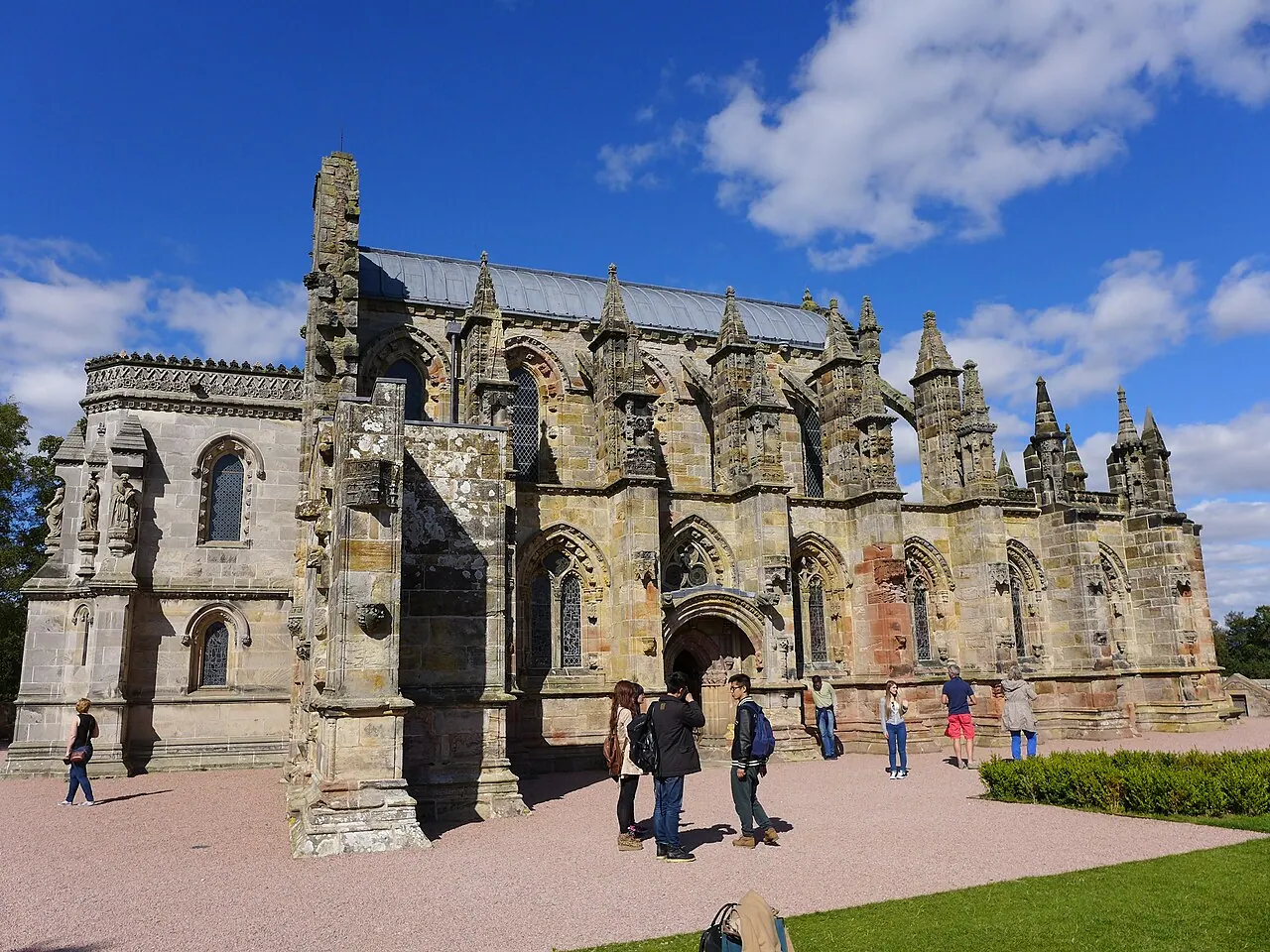
William Sinclair's collegiate chapel compresses an entire iconographic universe into a few bays: over a hundred Green Men, botanical carvings resembling New World maize decades before Columbus, the Apprentice Pillar with its double-helix vines, and 213 carved cubes whose patterns father-and-son researchers mapped to Chladni resonance figures, publishing the result as the 'Rosslyn Motet'. Grail romance, Templar lore and Freemasonic tradition have swirled around it for centuries — long before a certain novel.
See Rosslyn Chapel on the globe
Opens with the Resonance lens on, so you can see what it connects to.
Notable facts
- The 213 'musical cubes' map plausibly (though controversially) onto cymatic patterns.
- Legend says the master mason killed his apprentice for carving the finer pillar.
- The 17th-century St Clair Charters named the Sinclairs patrons of Scottish masons, and a later Sinclair became first Grand Master of the Grand Lodge of Scotland (1736) — but historians see Masonic readings of the 15th-century chapel as anachronistic, and the Templar treasure is not evidenced.
Through the theories
How each theory reads Rosslyn Chapel. Follow a theory to see its verdict and every other site it claims.
ResonanceMeasured; intent debated
The 213 carved cubes have been mapped to Chladni resonance patterns and performed as the 'Rosslyn Motet' — the boldest claim of frozen music in architecture.
Sacred GeometryA spectrum
The cymatics hypothesis treats the chapel as geometry of sound made visible — the boldest 'frozen music' claim in architecture.
Ley LinesMostly chance
Sits on the 'Rose Line' of esoteric tradition — popularised, then distorted, by The Da Vinci Code.