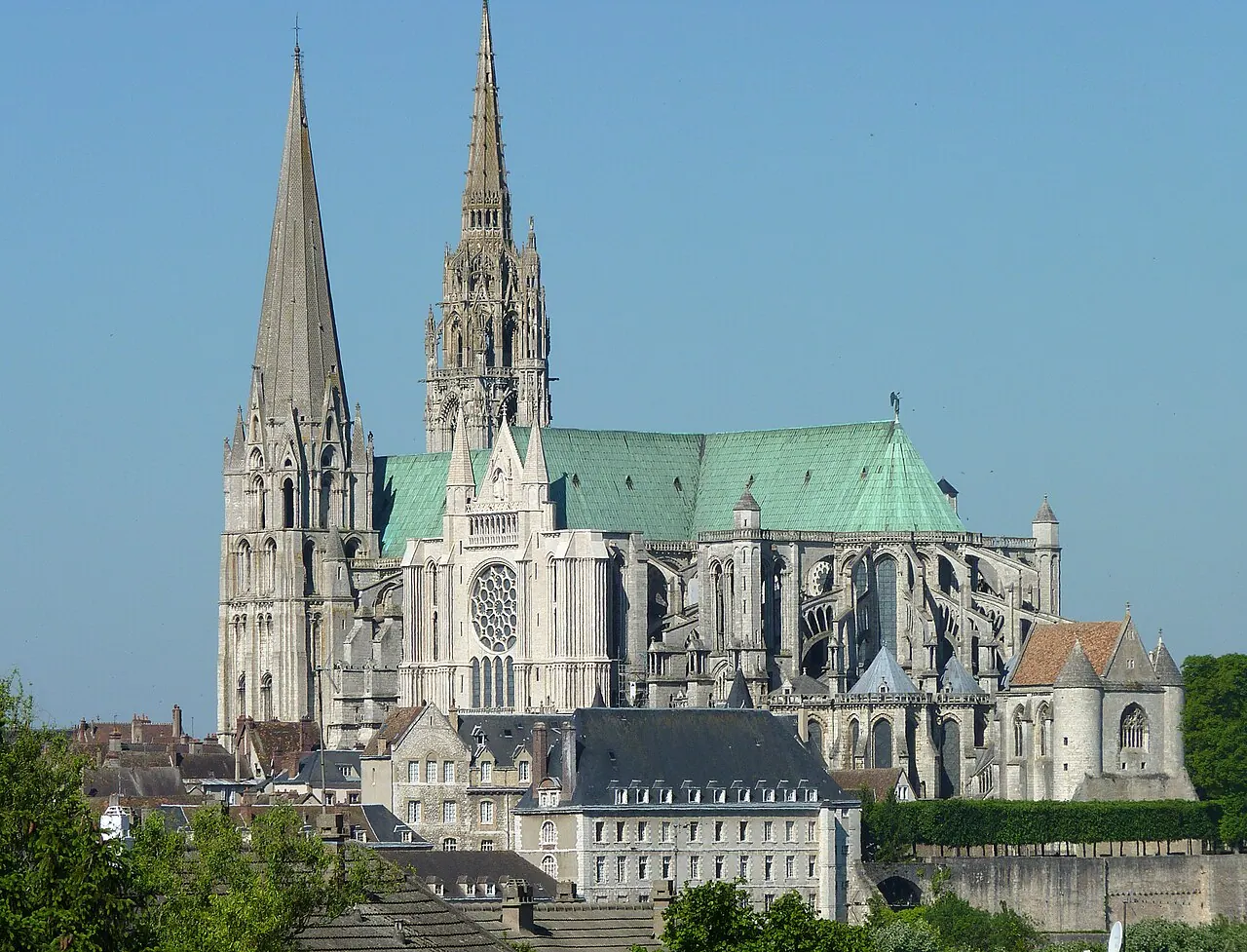
Chartres is the summa of the medieval masons' art: a building designed, its geometers argue, entirely from compass and straightedge — pentagons, √2 and √3 rectangles, and musical ratios in elevation. Its eleven-circuit labyrinth, walked as a substitute pilgrimage to Jerusalem, is the most famous pavement maze on Earth. Tradition claims the cathedral stands over a druidic grotto and holy well; its school made Plato's geometry a form of theology.
See Chartres Cathedral on the globe
Opens with the Sacred Geometry lens on, so you can see what it connects to.
Notable facts
- Rebuilt in just 26 years after the 1194 fire — extraordinary speed for a Gothic giant.
- The labyrinth (~12.9 m across) is roughly the size of the west rose window — though the popular claim that folding the facade down would lay one over the other is off by about 3 metres.
- The School of Chartres taught that God created the world 'by measure, number and weight'.
Through the theories
How each theory reads Chartres Cathedral. Follow a theory to see its verdict and every other site it claims.
Sacred GeometryA spectrum
The masterwork of applied sacred geometry — its proportional system is documented in the stone itself.
Ley LinesMostly chance
Louis Charpentier's 1966 bestseller claimed Chartres sits on a druidic 'wouivre' (earth current) node — a key text in the French earth-mysteries revival.
Earth GridNo measurable evidence
Charpentier also claimed the crypt's well and altar mark a telluric crossing that 'exalts' visitors.