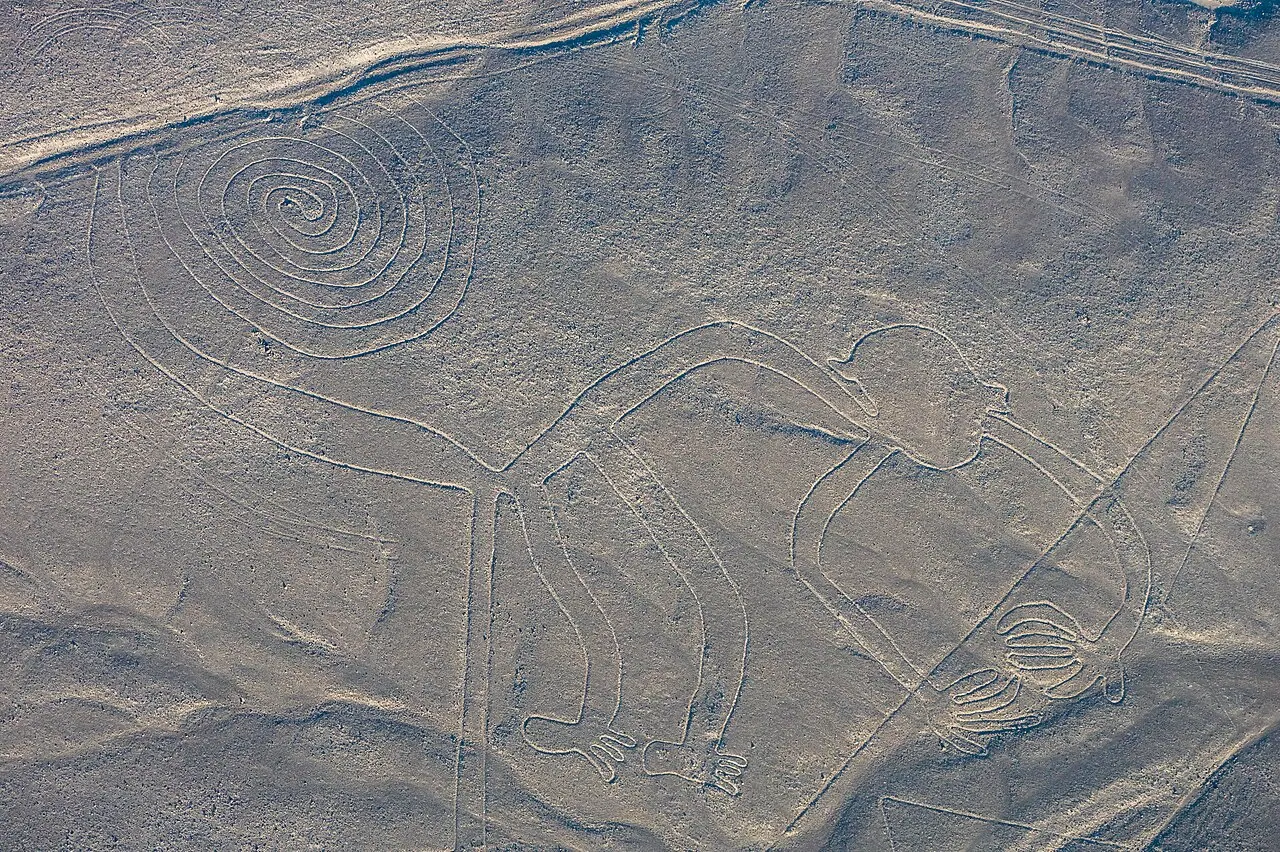
Across 450 km² of high desert, the Nazca people swept aside dark surface stones to draw in the pale earth beneath: hummingbirds, monkeys, spiders, and over 800 ruler-straight lines, some running for kilometres over hills without deviating. The hyper-arid climate has preserved them for two thousand years. Most scholars link them to water ritual and processional walking; Maria Reiche saw a star calendar; others see routes to underground aquifers.
See Nazca Lines on the globe
Opens with the Sky Alignments lens on, so you can see what it connects to.
Notable facts
- The 'spider' figure is drawn in a single continuous line — likely a walkable ritual path.
- Puquios, spiral-mouthed underground aqueducts nearby, still function today.
- New geoglyphs are still being found by drone and AI surveys — over 300 more since 2020.
Through the theories
How each theory reads Nazca Lines. Follow a theory to see its verdict and every other site it claims.
Sky AlignmentsEstablished science
Paul Kosok and Maria Reiche argued some lines marked solstice points on the horizon (Kosok also proposed Pleiades risings), and Reiche read the monkey as the Big Dipper; later writers mapped the spider to Orion — though Hawkins and Aveni found no statistically significant alignments overall.
Ley LinesMostly chance
The straight lines' indifference to terrain made Nazca the South American exhibit A for ley-line hunters; Tony Morrison linked them to Andean ceque sightlines.
Earth GridNo measurable evidence
Erich von Däniken's 'runways' claim made Nazca ground zero for ancient-astronaut speculation.
AstronautsNo physical evidence
Von Däniken's 'runways' made Nazca the founding image of the genre — figures legible only from the sky, read as messages to it.