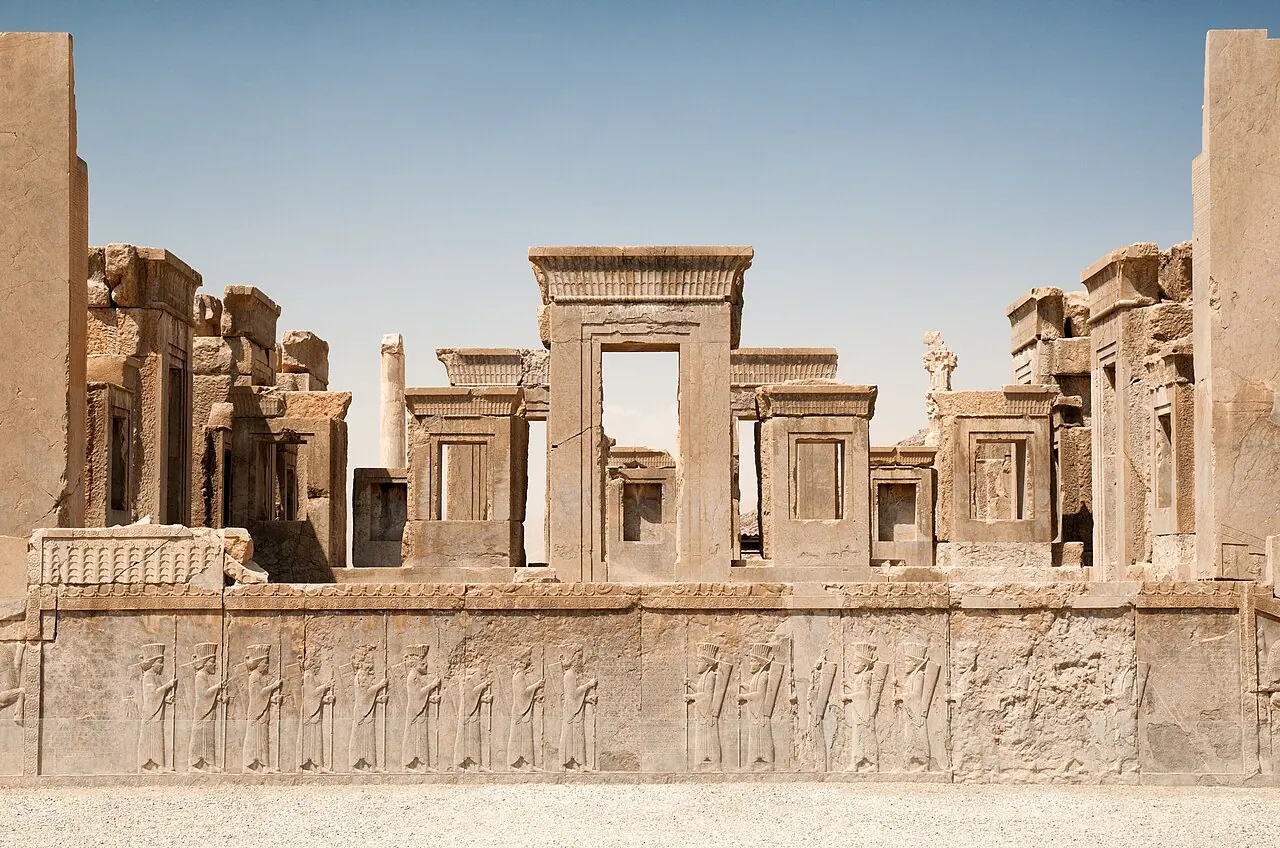
Darius the Great raised Persepolis as the ritual stage of the Achaemenid empire: a half-natural, half-built terrace bearing halls of a hundred columns, guarded by human-headed bulls, approached by staircases shallow enough for dignified robes. Reliefs show 23 subject nations bringing tribute — an empire portrayed not conquering but processing. Its orientation has been argued to frame the sunrise of the spring equinox, the Persian New Year (Nowruz) still celebrated 2,500 years later. Alexander burned it in 330 BCE, reportedly after a drinking party.
See Persepolis on the globe
Opens with the Sky Alignments lens on, so you can see what it connects to.
Notable facts
- Columns of the Apadana stood some 20–24 m tall, among antiquity's highest.
- Gold and silver foundation tablets were found in stone boxes beneath the Apadana corners.
- Trilingual inscriptions here helped crack cuneiform.
Through the theories
How each theory reads Persepolis. Follow a theory to see its verdict and every other site it claims.
Sky AlignmentsEstablished science
The equinox/Nowruz alignment hypothesis ties imperial ritual to the solar year — appropriate for a solstice-to-equinox empire of light-worship.
Ley LinesMostly chance
A named station on Alison's great circle between Ur and Mohenjo-daro.