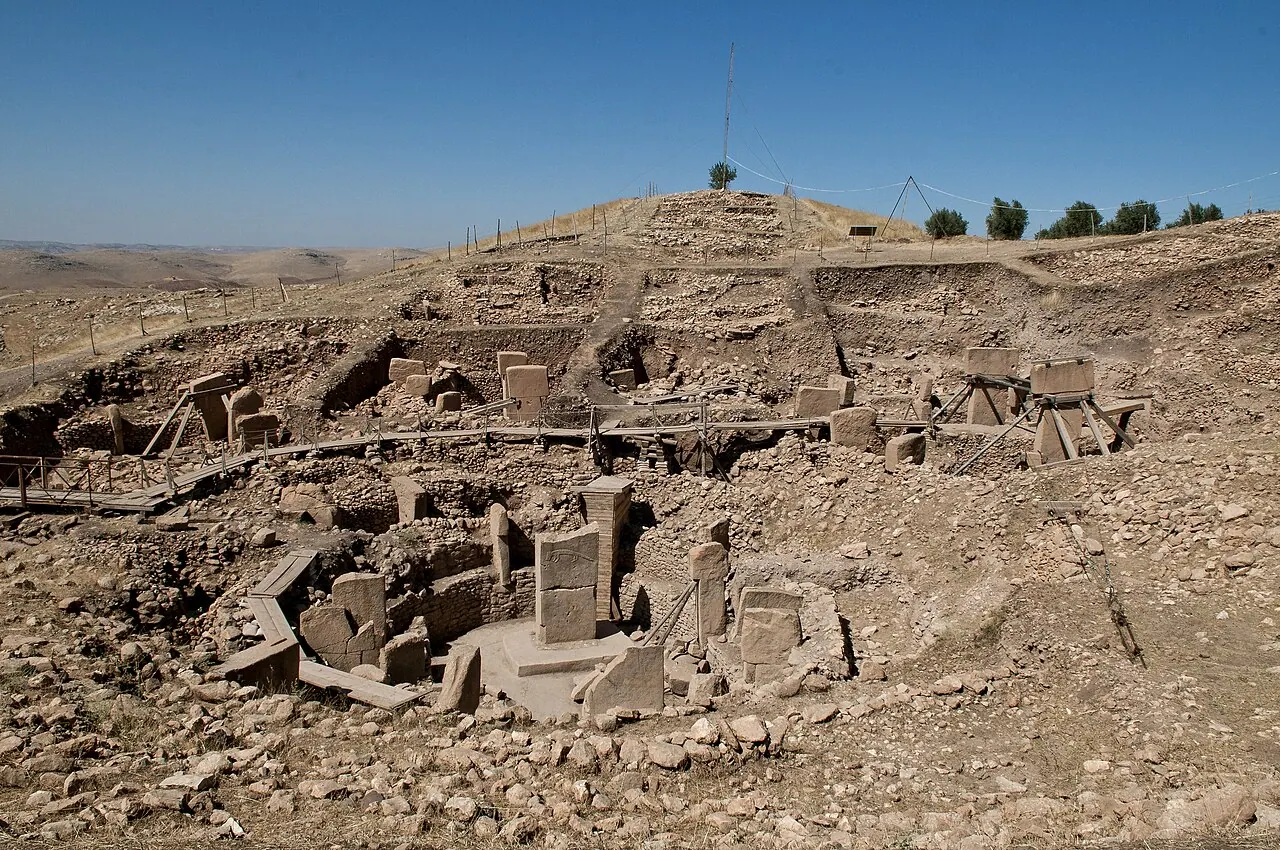
On a hill in the Germuş mountains, T-shaped limestone pillars up to 5.5 metres and 10 tonnes stand in ovals, carved with foxes, snakes, scorpions and vultures — raised around 9500 BCE, before pottery, metallurgy, writing or agriculture. Its excavator Klaus Schmidt called it 'first the temple, then the city': the labour of worship, he argued, may have driven the invention of farming rather than followed it. Only a fraction is excavated; ground radar shows many more enclosures waiting.
See Göbekli Tepe on the globe
Opens with the Sky Alignments lens on, so you can see what it connects to.
Notable facts
- Roughly 6,500 years older than Stonehenge; contemporary with the end of the Ice Age.
- The pillars are stylised humans — arms, hands and belts are carved in low relief.
- The enclosures lay buried under fill for millennia — once read as deliberate ritual burial, now thought by the excavators to be largely the work of landslides, collapse and rebuilding.
Through the theories
How each theory reads Göbekli Tepe. Follow a theory to see its verdict and every other site it claims.
Sky AlignmentsEstablished science
Contested claims link Pillar 43 (the 'Vulture Stone') to the Younger Dryas comet and to Sirius or Cygnus sightlines.
Sacred GeometryA spectrum
2020 research (Haklay & Gopher) found the three main enclosures form an equilateral triangle — hinting at a single planned design.
Lost WorldRejected by mainstream
Its 9500 BCE date is the cornerstone of the modern argument: monumental building at exactly the moment a destroyed civilisation's survivors would have needed to regroup — so the reading goes.
Earth GridNo measurable evidence
Graham Hancock's 'lost civilisation' argument leans heavily on Göbekli's impossible earliness.