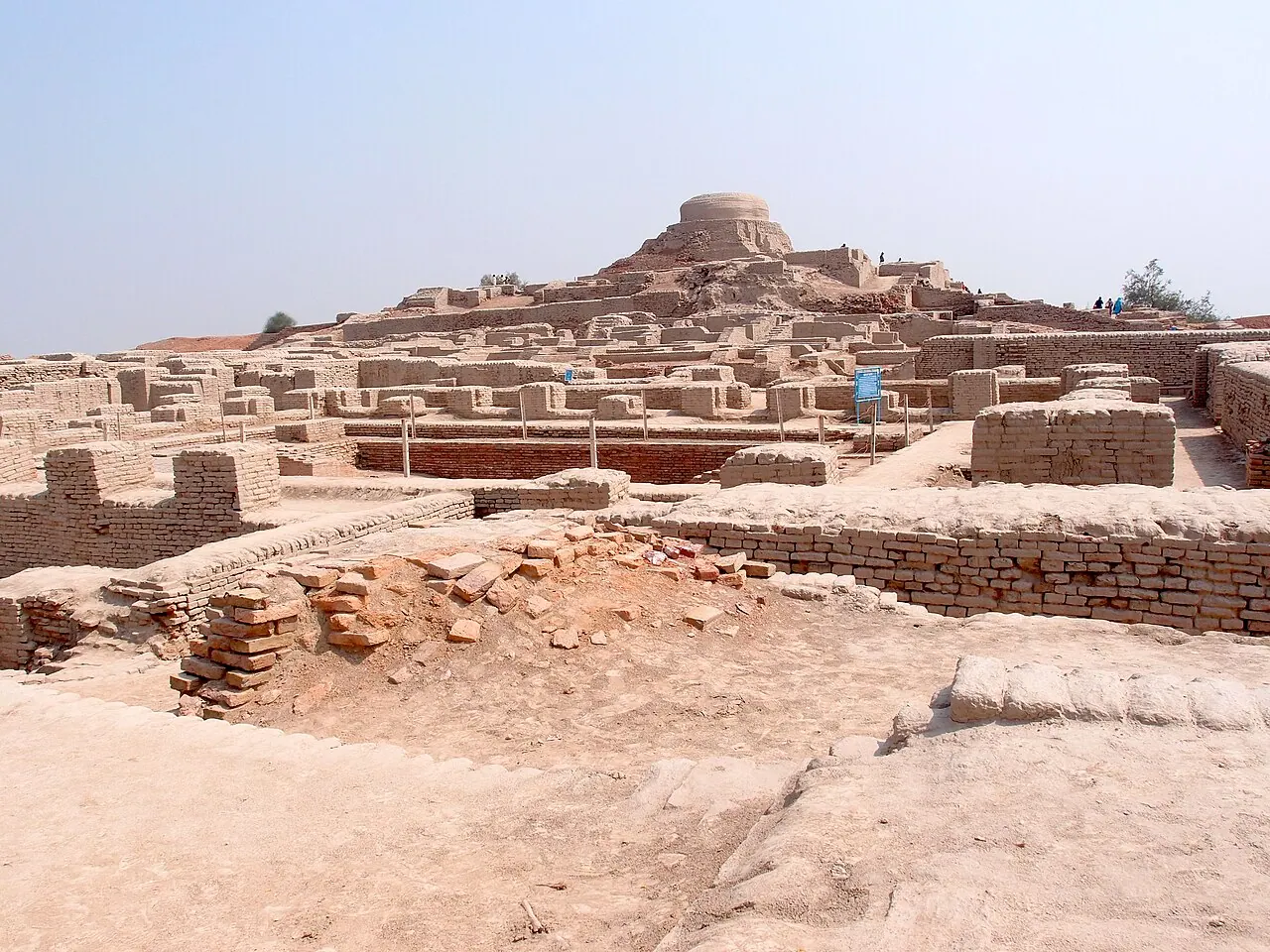
The greatest city of the Indus civilisation was built of standardised baked brick on a planned grid, with covered drains, private bathrooms and the watertight Great Bath — perhaps the world's first public ritual pool. Its script is undeciphered; its rulers, if any, are invisible; its art is modest (the 'Priest-King' and the bronze 'Dancing Girl'). It was abandoned, most likely as the Indus shifted and the monsoon weakened. Later lore about 'vitrified ruins' and ancient catastrophe is unsupported by excavation — the city probably died of water, not war.
See Mohenjo-daro on the globe
Opens with the Ley Lines lens on, so you can see what it connects to.
Notable facts
- Uniform brick ratios (1:2:4) across the whole Indus realm imply shared standards over 1,500 km.
- The Great Bath was sealed with bitumen — perhaps the oldest known setting for the ritual bathing that still runs through South Asian religion.
- No temple, palace, or royal tomb has ever been positively identified.
Through the theories
How each theory reads Mohenjo-daro. Follow a theory to see its verdict and every other site it claims.
Ley LinesMostly chance
A station on Alison's great-circle list between Persepolis and Khajuraho.
Earth GridNo measurable evidence
The 'radioactive skeletons / ancient nuclear war' legend attached to it is thoroughly debunked but immortal on the internet.