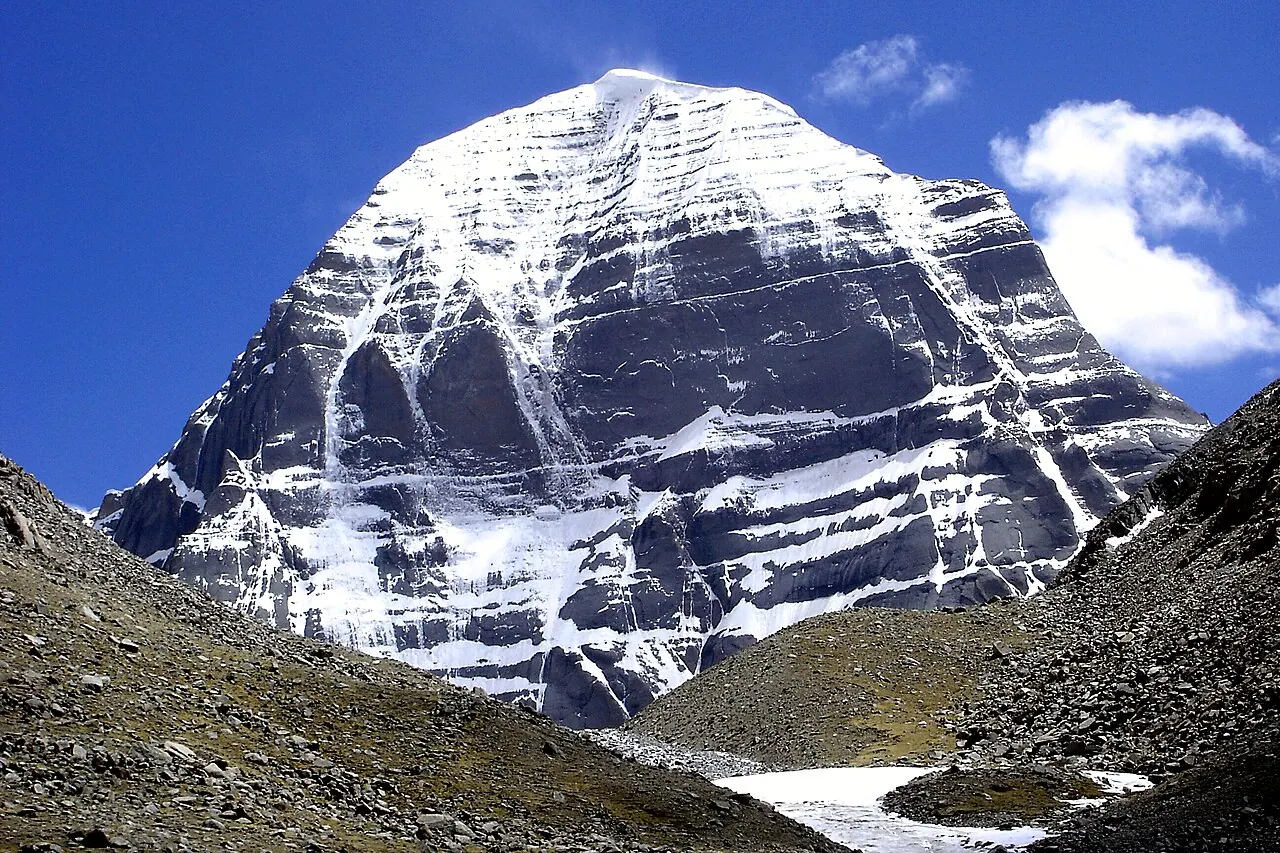
Kailash is the axis mundi made literal: to Hindus the throne of Shiva, to Buddhists the palace of Demchok, to Jains the liberation-place of their first saint, to Bönpos the nine-story swastika mountain. Four of Asia's great rivers — Indus, Sutlej, Brahmaputra, Karnali (Ganges tributary) — rise within 100 km of it, flowing to the four directions. Pilgrims circle its 52 km kora; the devout complete 108 circuits. It has never been climbed: China offered Reinhold Messner the chance in the 1980s and he declined, a Spanish expedition's plans in 2001 were blocked amid protest, and climbing is now prohibited.
See Mount Kailash on the globe
Opens with the Axis Mundi lens on, so you can see what it connects to.
Notable facts
- The four-rivers geography is real hydrology arranged like theology.
- Its striated south face forms a natural swastika of rock and snow — the Bön 'nine-story' mountain.
- A single kora at altitude crosses the 5,630 m Drölma pass — pilgrimage as ordeal.
Through the theories
How each theory reads Mount Kailash. Follow a theory to see its verdict and every other site it claims.
Axis MundiEstablished anthropology
The literal axis mundi of four living religions — the unclimbed pole at the centre of the world-mandala, ringed by four great rivers.
Sacred GeometryA spectrum
Alternative writers note its latitude and claimed distance symmetries to Stonehenge and Giza; the four-river mandala is the older, deeper geometry.
Ley LinesMostly chance
The archetype of the axis mundi — the concept ley and grid theories secularise.
Earth GridNo measurable evidence
Russian 'Kailash pyramid' literature claims it is an artificial structure at the heart of a global monument web — geology says layered conglomerate on a granite base; the myth says otherwise.