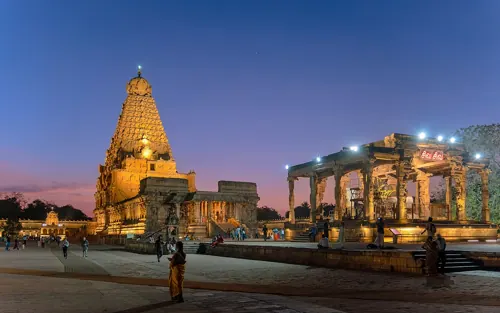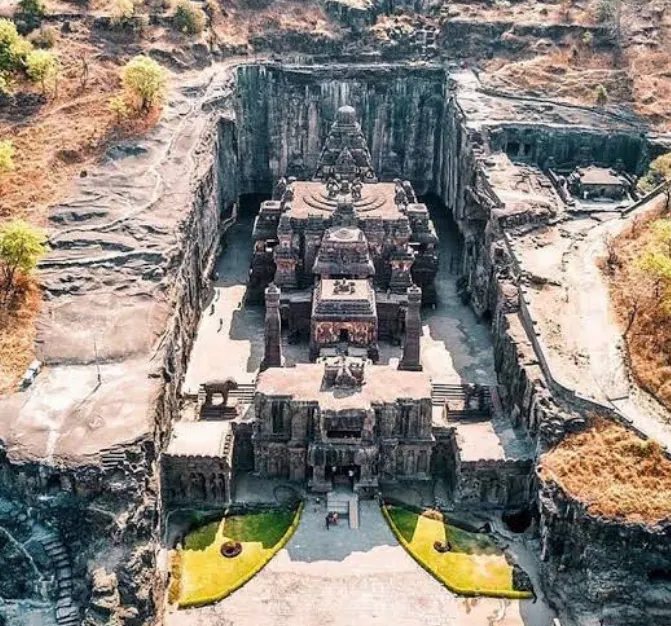
The Rashtrakuta king Krishna I set masons at the top of a basalt cliff and had them cut down and inward, releasing a two-storey temple, its gateway, its shrines and a full-size stone elephant from the living rock. By popular estimate some 200,000 tonnes of basalt were removed and none of it was ever put back. Because the work was subtractive there was no scaffolding, no trial assembly and no way to correct a mistake: a misplaced chisel could not be replaced, only designed around. Kailasa is Cave 16 of thirty-four at Ellora, where Buddhist, Hindu and Jain monuments stand side by side along the same escarpment.
See Kailasa Temple, Ellora on the globe
Opens with the Sacred Geometry lens on, so you can see what it connects to.
Notable facts
- Cut from the top down, so the roof was finished before the floor existed.
- Popular estimates for the rock removed run to around 200,000 tonnes, though figures vary widely; what became of the spoil is not recorded.
- The thirty-four caves hold Buddhist, Hindu and Jain shrines side by side along some two kilometres of the same cliff.
Through the theories
How each theory reads Kailasa Temple, Ellora. Follow a theory to see its verdict and every other site it claims.
Sacred GeometryA spectrum
The plan follows Dravidian temple proportion despite being released from rock rather than assembled to a line.
Lost WorldRejected by mainstream
The standard exhibit in 'how was this done' literature: a building with no margin for error and no surviving record of its method.
AstronautsNo physical evidence
Ancient-astronaut writers point to the volume removed and the missing spoil as evidence of tooling we have lost.