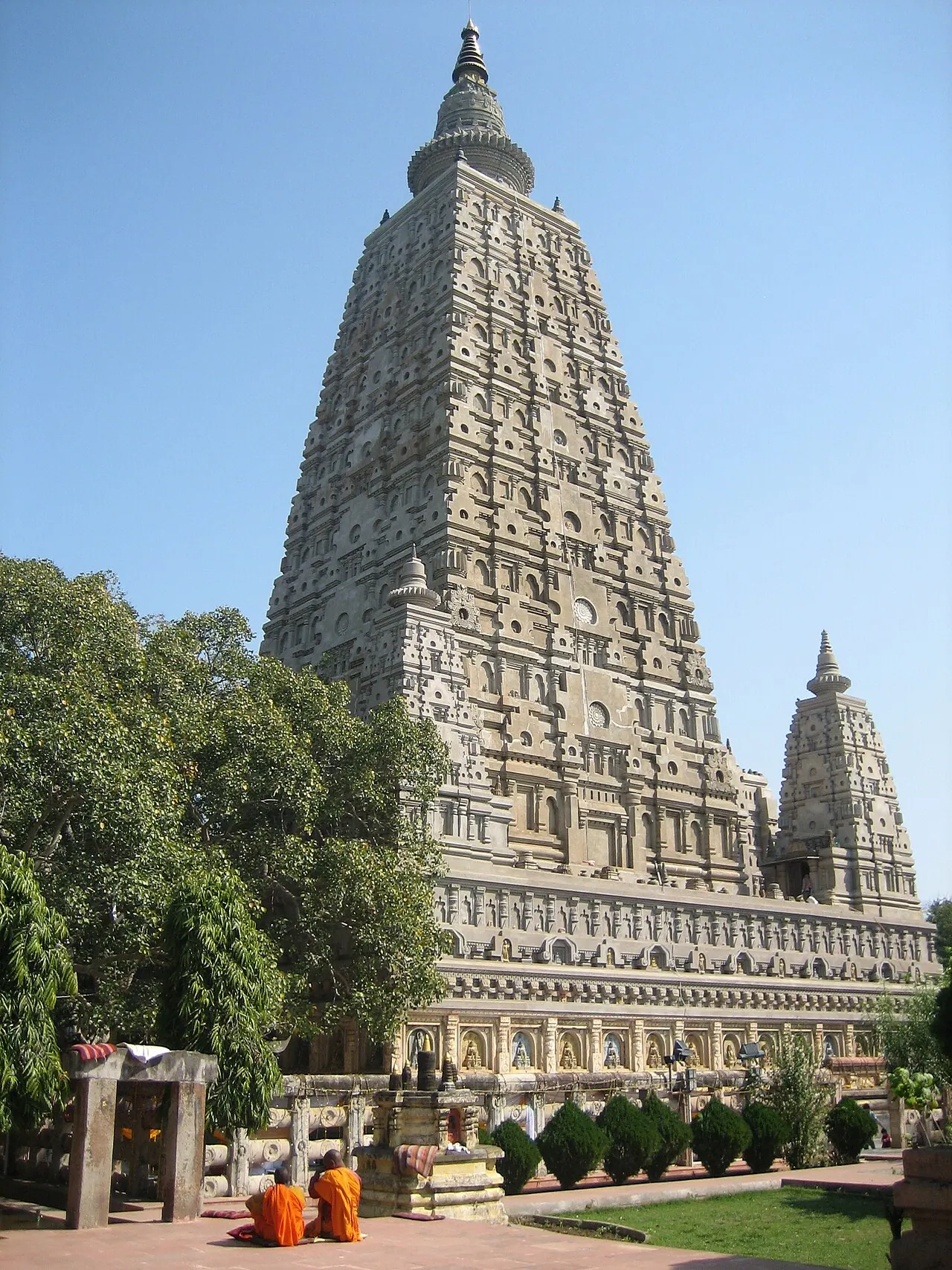
Under a pipal tree here, Siddhartha Gautama became the Buddha. The spot — the vajrasana, 'diamond throne' — is held in Buddhist cosmology to be the immovable point of the universe, the last place to vanish at a world's end and the first to reform. The Mahabodhi Temple's 50-metre pyramid tower, an architectural rarity, has drawn pilgrims from every Buddhist land for 1,500 years; the current Bodhi Tree, planted in 1881, is held to be a cutting-of-a-cutting of the original, returned via Sri Lanka.
See Bodh Gaya on the globe
Opens with the Axis Mundi lens on, so you can see what it connects to.
Notable facts
- Emperor Ashoka marked the site with the Vajrasana slab in the 3rd century BCE.
- By tradition, a branch of the Bodhi Tree was carried to Sri Lanka in 288 BCE, and a cutting of it was brought back after the original died.
- The temple is one of the earliest surviving all-brick towers in India.
Through the theories
How each theory reads Bodh Gaya. Follow a theory to see its verdict and every other site it claims.
Axis MundiEstablished anthropology
The vajrasana is the immovable point of the universe — the last place to vanish when a world ends and the first to re-form.
Sacred GeometryA spectrum
The vajrasana is Buddhism's own 'navel of the world' — the axis mundi as a point of consciousness rather than stone.