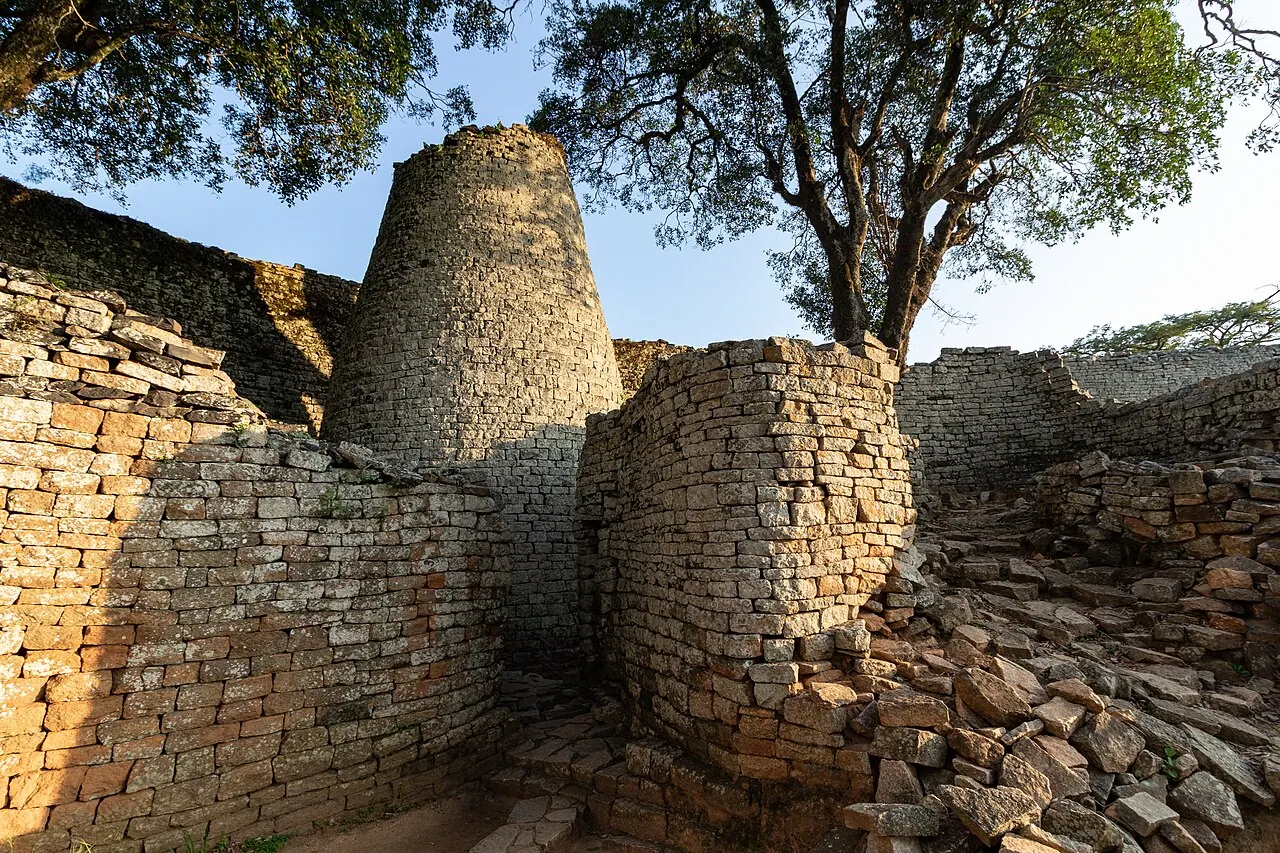
The capital of a Shona trading empire, Great Zimbabwe's Great Enclosure is the largest ancient structure south of the Sahara: 250 metres of curved drystone wall, nearly a million granite blocks, and the enigmatic 10-metre Conical Tower — solid, doorless, purpose unknown. Eight soapstone birds, now national symbols, watched from its heights. Colonial archaeology attributed it to Phoenicians, Arabs, anyone but Africans; David Randall-MacIver's 1905 excavations and Gertrude Caton-Thompson's in 1929 settled it: African, medieval, magnificent.
See Great Zimbabwe on the globe
Opens with the Sky Alignments lens on, so you can see what it connects to.
Notable facts
- Chinese porcelain, Persian faience and Arabian glass excavated here map an Indian Ocean trade web.
- The Conical Tower is completely solid — a granary symbol, a chief's emblem, or something else entirely.
- The name comes from Shona 'dzimba dzemabwe' — houses of stone.
Through the theories
How each theory reads Great Zimbabwe. Follow a theory to see its verdict and every other site it claims.
Sky AlignmentsEstablished science
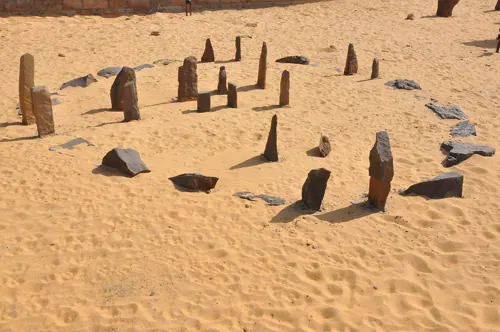
Richard Wade and others have proposed the eastern enclosure's monoliths tracked stars including a possible supernova — contested but intriguing.
Sacred GeometryA spectrum
The Great Enclosure's curves follow the granite landscape rather than imposed axes — an architecture of flow, not grid.