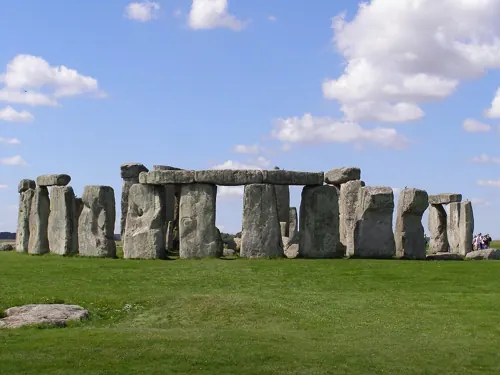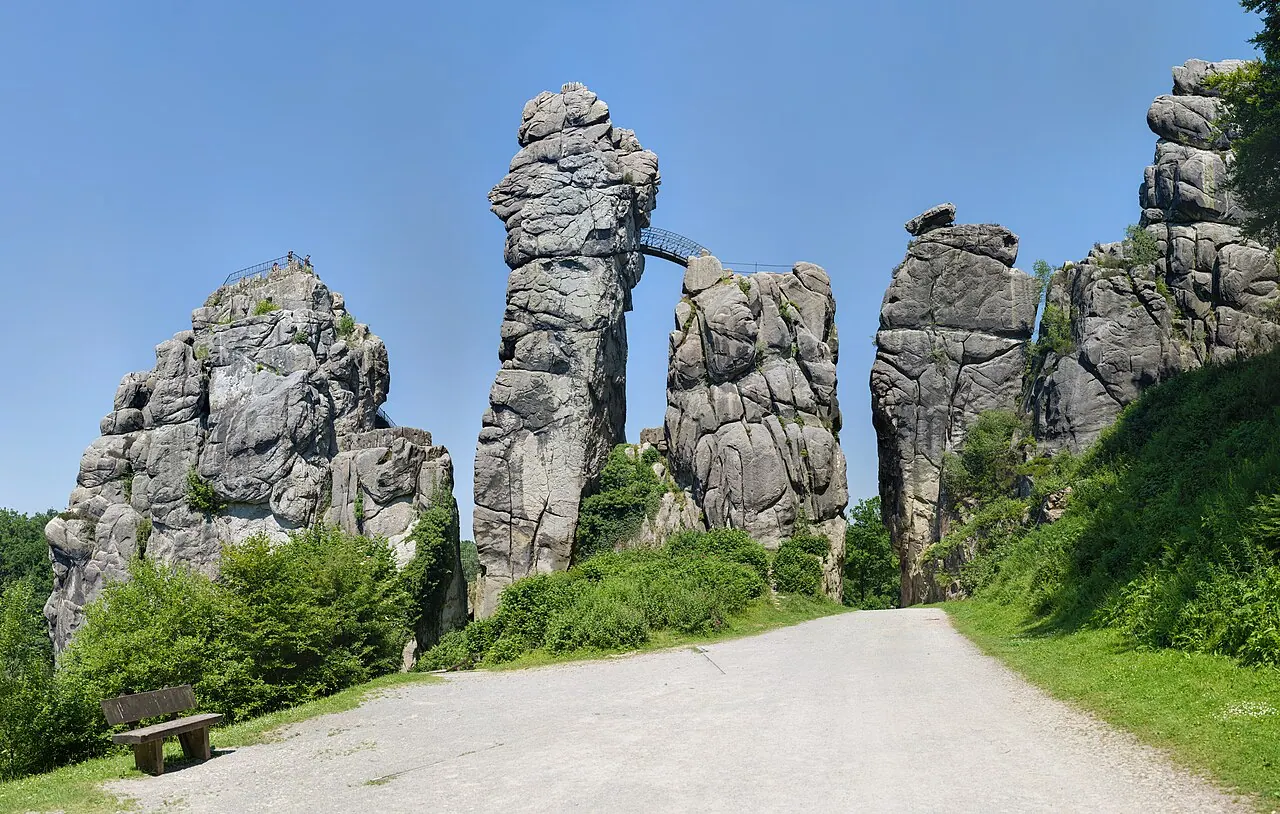
The Externsteine pillars have collected two millennia of speculation: Saxon sanctuary of Irminsul, hermit refuge, pilgrimage station. High on one pillar, a rock-cut chapel's circular window faces the summer solstice sunrise; some astronomers argue its axis also points to the moon's northernmost path, reached only every 18.6 years. The site became notorious when Himmler's Ahnenerbe excavated it seeking a Germanic Stonehenge — a cautionary tale in how earth-mysteries can be weaponised. The genuine medieval rock reliefs, including a Descent from the Cross, are among Germany's finest.
See Externsteine on the globe
Opens with the Sky Alignments lens on, so you can see what it connects to.
Notable facts
- The 'sacellum' window aligns to midsummer sunrise azimuth.
- In the Descent from the Cross relief (c. 1160/70), Nicodemus stands on a bent object that Wilhelm Teudt in 1929 read as the Irminsul, the Saxon world-pillar, bowed beneath the cross; most scholars see a bent plant or a chair.
- Wilhelm Teudt's 1920s 'heilige Linien' (holy lines) theory — Germany's ley lines — was centred here.
Through the theories
How each theory reads Externsteine. Follow a theory to see its verdict and every other site it claims.
Sky AlignmentsEstablished science
The solstice window is measurable; intent is likely for the medieval chapel, debated for earlier use.
Ley LinesMostly chance
Teudt's heilige Linien made Externsteine the German ley capital; the idea's later Nazi adoption is the movement's darkest chapter.