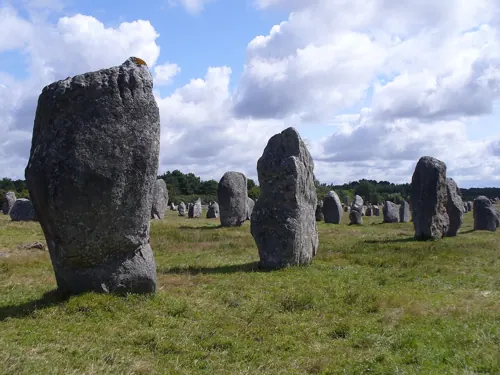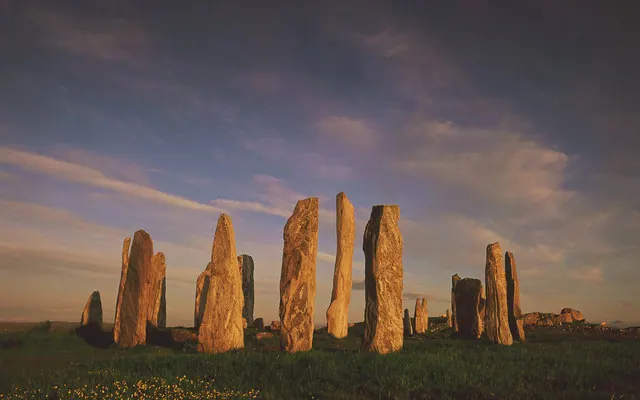
On a Hebridean ridge, thirteen tall gneiss stones ring a central monolith, with avenues running out in four directions — a cruciform plan older than the pyramids of Giza. Every 18.6 years, at the major lunar standstill, the full moon skims the horizon along the hills called 'The Old Woman of the Moors', appearing to walk the earth before setting into the circle. Crowds still gather for it; the most recent standstill season peaked in 2024–25.
See Calanais on the globe
Opens with the Sky Alignments lens on, so you can see what it connects to.
Notable facts
- The stones are Lewisian gneiss — at ~3 billion years old, among the oldest rock in Europe.
- At the major standstill the moon rises and sets within the frame of the surrounding hills as seen along the avenue.
- A local legend calls the stones 'fir bhrèige' — false men, giants who refused Christianity.
Through the theories
How each theory reads Calanais. Follow a theory to see its verdict and every other site it claims.
Sky AlignmentsEstablished science
The standstill spectacle is real, rare and repeatable — lunar archaeoastronomy's flagship site.
Ley LinesMostly chance
The four avenues read as sightlines; Watkins-tradition writers link Calanais into Hebridean ley webs.