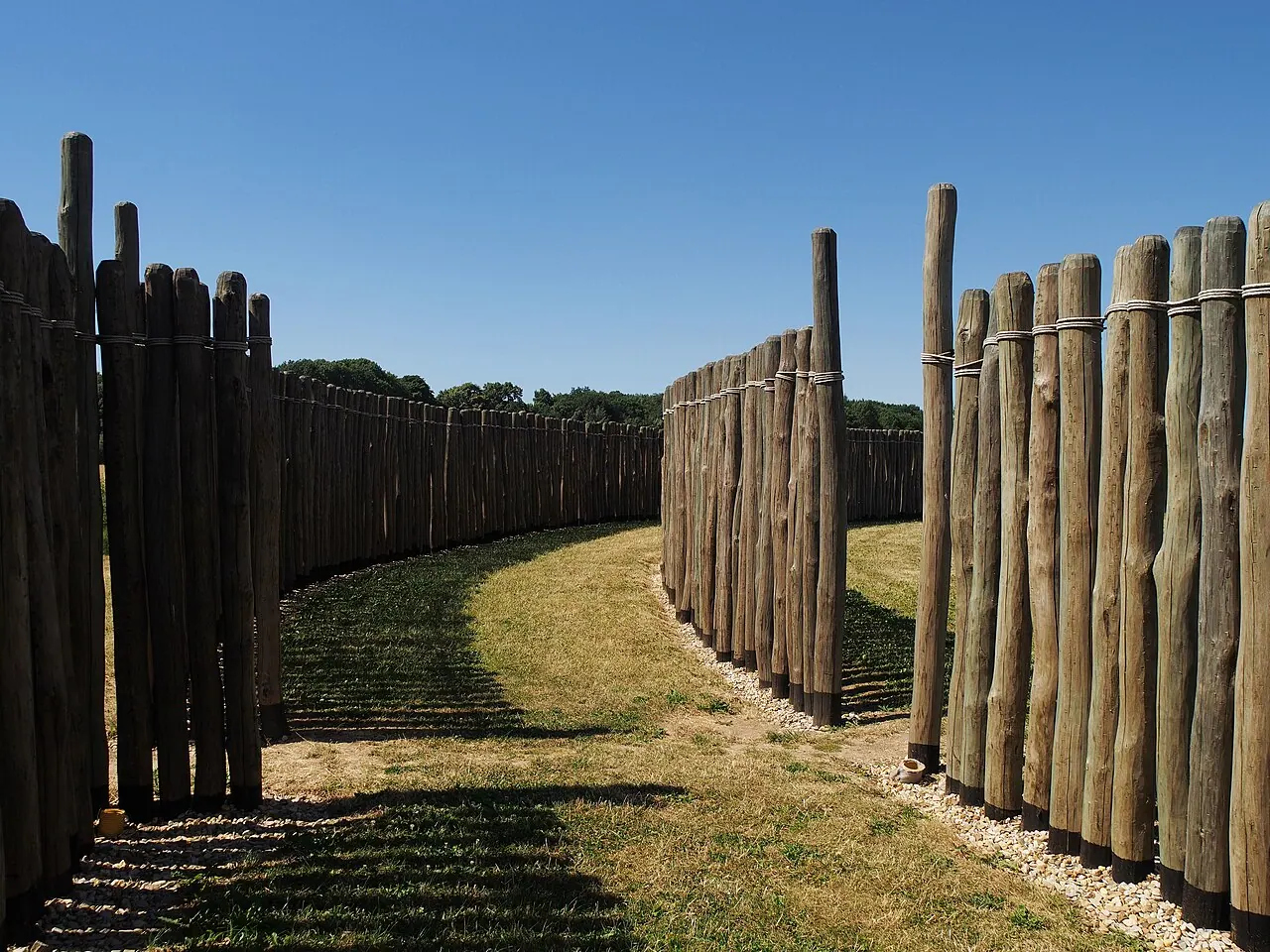
Discovered as a cropmark from the air in 1991, the Goseck ring is a 75-metre circular enclosure of concentric palisades with three gates. Two of the gates frame the winter solstice sunrise and sunset as seen from the centre — dated to ~4900 BCE, it is arguably the oldest deliberate solar instrument known. It belongs to a family of some 140 Central European ring enclosures, most of which show similar solstice alignments.
See Goseck Circle on the globe
Opens with the Sky Alignments lens on, so you can see what it connects to.
Notable facts
- Predates Stonehenge by nearly two millennia.
- The nearby Nebra Sky Disc — the oldest known portable depiction of the cosmos — was found 25 km away.
- Reconstructed with 1,675 oak posts on the original postholes.
Through the theories
How each theory reads Goseck Circle. Follow a theory to see its verdict and every other site it claims.
Sky AlignmentsEstablished science
The winter-solstice gate geometry is precise and accepted — foundational evidence that Neolithic Europe systematically watched the sky.
Sacred GeometryA spectrum
Circle-and-gate design repeated across some 140 enclosures suggests, to proponents, a shared geometric canon in 5000 BCE Europe.