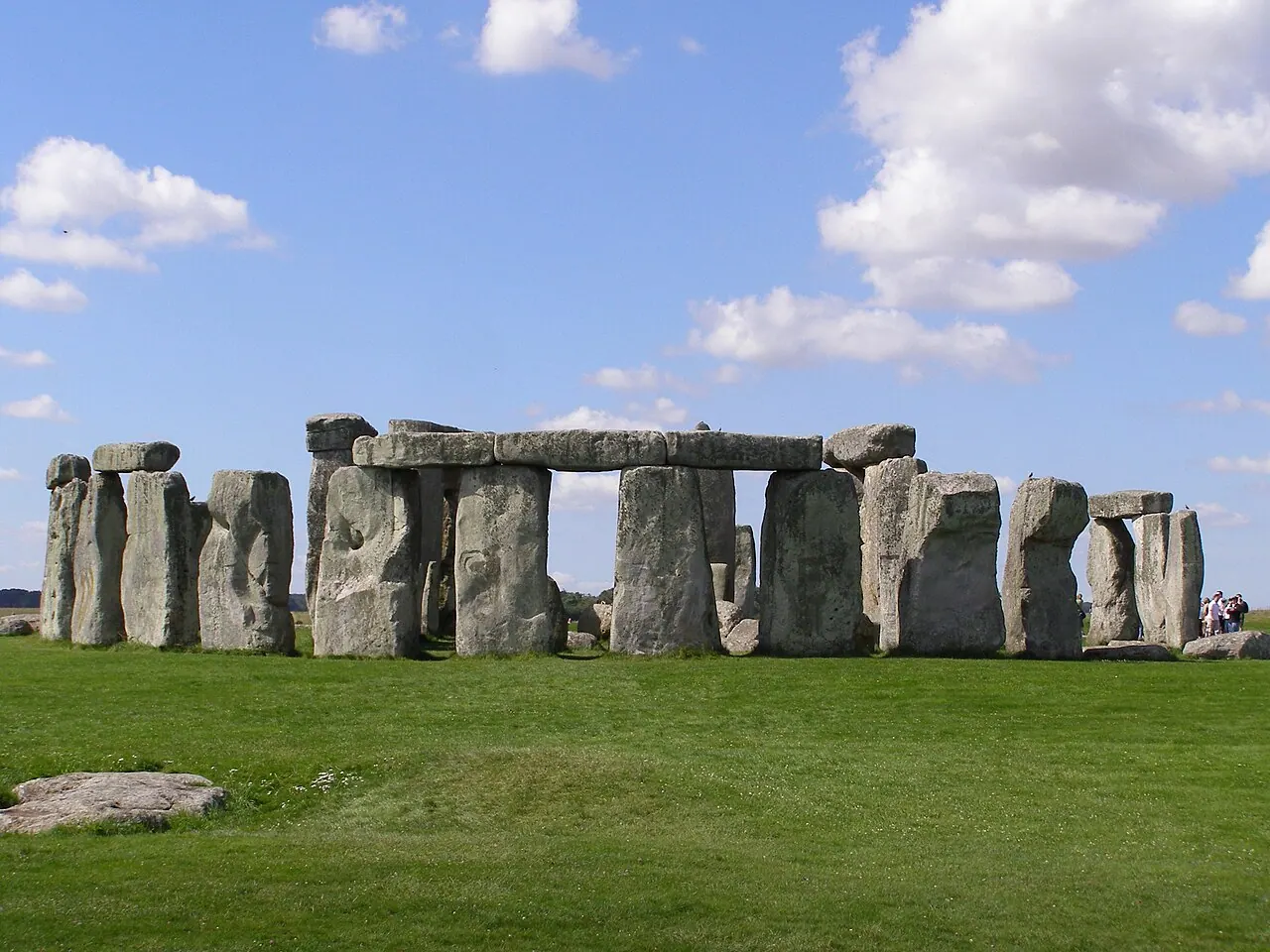
Built in phases over 1,500 years, Stonehenge pairs colossal local sarsens with 2–5 tonne bluestones hauled (or glacially rafted — the debate persists) from the Preseli Hills of Wales. The monument's axis frames the midsummer sunrise and midwinter sunset. It stands within a ritual landscape of barrows, avenues and the vast henge of Durrington Walls, where its builders feasted at midwinter.
See Stonehenge on the globe
Opens with the Sky Alignments lens on, so you can see what it connects to.
Notable facts
- Some bluestones ring like bells when struck — the Preseli outcrops are 'lithophonic'.
- The Station Stones form a rectangle whose sides align to solstice and lunar extremes — only possible near this exact latitude.
- Isotope analysis of feast pigs suggests animals were brought from across Britain — possibly from as far as Scotland.
Through the theories
How each theory reads Stonehenge. Follow a theory to see its verdict and every other site it claims.
Sky AlignmentsEstablished science
Gerald Hawkins' 'Stonehenge Decoded' (1965) argued it is a Neolithic eclipse computer using the 56 Aubrey Holes.
ResonanceMeasured; intent debated
The Preseli bluestones are lithophones — some ring like bells when struck, and a 'bluestone soundscape' theory argues they were hauled 240 km for their voice.
Sacred GeometryA spectrum
The Station Stone 5:12 rectangle and nested circle geometry are claimed as deliberate Pythagorean knowledge a millennium before Pythagoras.
Ley LinesMostly chance
The alignment of Stonehenge, Old Sarum, Salisbury Cathedral and Clearbury Ring, noted by the astronomer Norman Lockyer in the early 1900s and now called the 'Old Sarum ley', predates Alfred Watkins' 1921 ley insight and remains the most cited ley of all.
Earth GridNo measurable evidence
Earth-mysteries writers place it at the centre of a web of alignments and 'energy lines'; dowsers report crossing 'energy streams' beneath the circle.