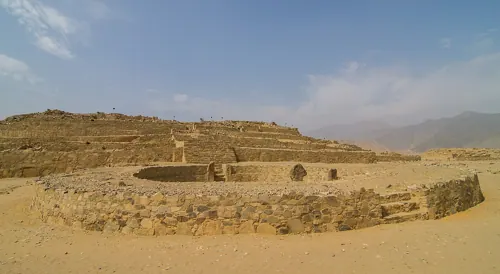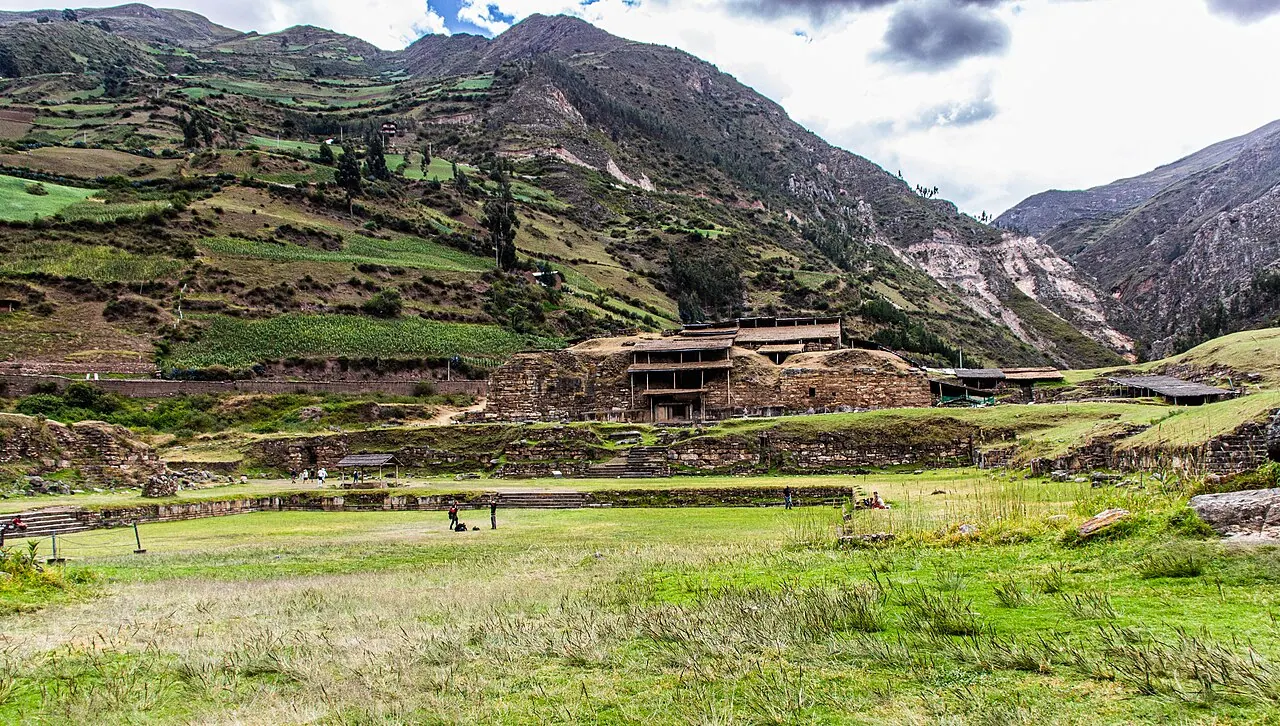
High in the Cordillera Blanca, Chavín was the pilgrimage oracle of the early Andes. Its temple is honeycombed with windowless galleries where initiates, likely dosed with psychoactive San Pedro cactus, met the Lanzón: a 4.5-metre blade of granite carved with a fanged deity, still standing in situ where it was raised three thousand years ago. Water channels beneath the plazas could be made to roar like applause through the stone.
See Chavín de Huántar on the globe
Opens with the Resonance lens on, so you can see what it connects to.
Notable facts
- Conch-shell trumpets (pututus) found here produce tones the galleries amplify into disorienting resonance.
- Acoustic research (Stanford) shows the galleries filter sound to a frequency band matching the pututus.
- The Lanzón sits at a crossing of underground channels — axis mundi in the most literal sense.
Through the theories
How each theory reads Chavín de Huántar. Follow a theory to see its verdict and every other site it claims.
ResonanceMeasured; intent debated
Stanford acousticians showed the galleries filter sound to match the frequency band of the pututu conch trumpets found on site — architecture as instrument.
Sacred GeometryA spectrum
Temple plan is a nested set of squares and crosses echoing Andean cosmological quadripartition.
Earth GridNo measurable evidence
The intentional acoustic engineering is real, measured, and ancient — the strongest legitimate cousin of 'resonance' theories.