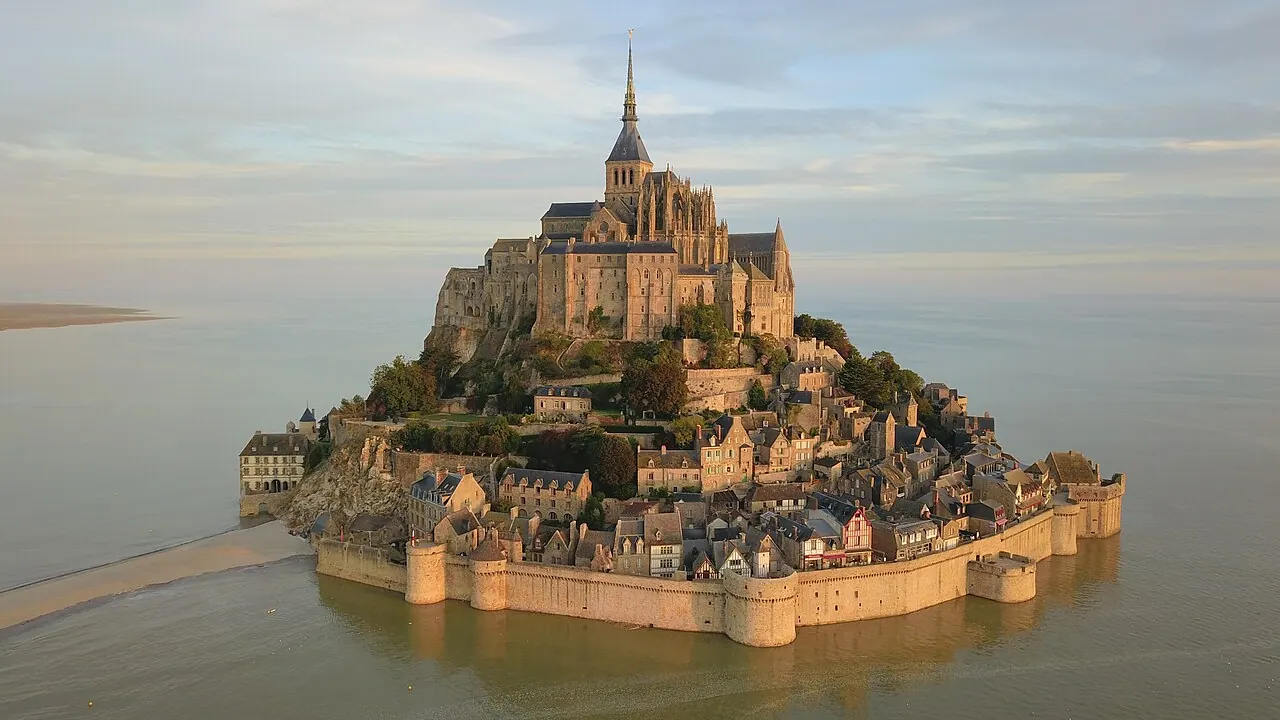
According to legend, the Archangel Michael appeared to Bishop Aubert in 708 and — when ignored twice — burned a hole in his skull with a fingertip. The abbey that resulted, stacked over centuries into a gravity-defying Gothic mountain, became one of medieval Europe's great pilgrimages. The bay's tides, the highest in Europe, made the crossing itself an ordeal of faith: pilgrims risked quicksand and a sea said to return 'at the speed of a galloping horse'.
See Mont-Saint-Michel on the globe
Opens with the Sacred Geometry lens on, so you can see what it connects to.
Notable facts
- Aubert's skull, complete with hole, is displayed in Avranches.
- The abbey church's crossing sits exactly on the rock's summit point.
- Its silhouette pairs with St Michael's Mount in Cornwall — sister islands on the same axis.
Through the theories
How each theory reads Mont-Saint-Michel. Follow a theory to see its verdict and every other site it claims.
Sacred GeometryA spectrum
The Gothic choir's geometry follows the medieval masons' canon: ad quadratum and ad triangulum construction.
Ley LinesMostly chance
Third station of the continental Michael–Apollo alignment, after Skellig Michael and St Michael's Mount, running southeast toward Italy and Greece.