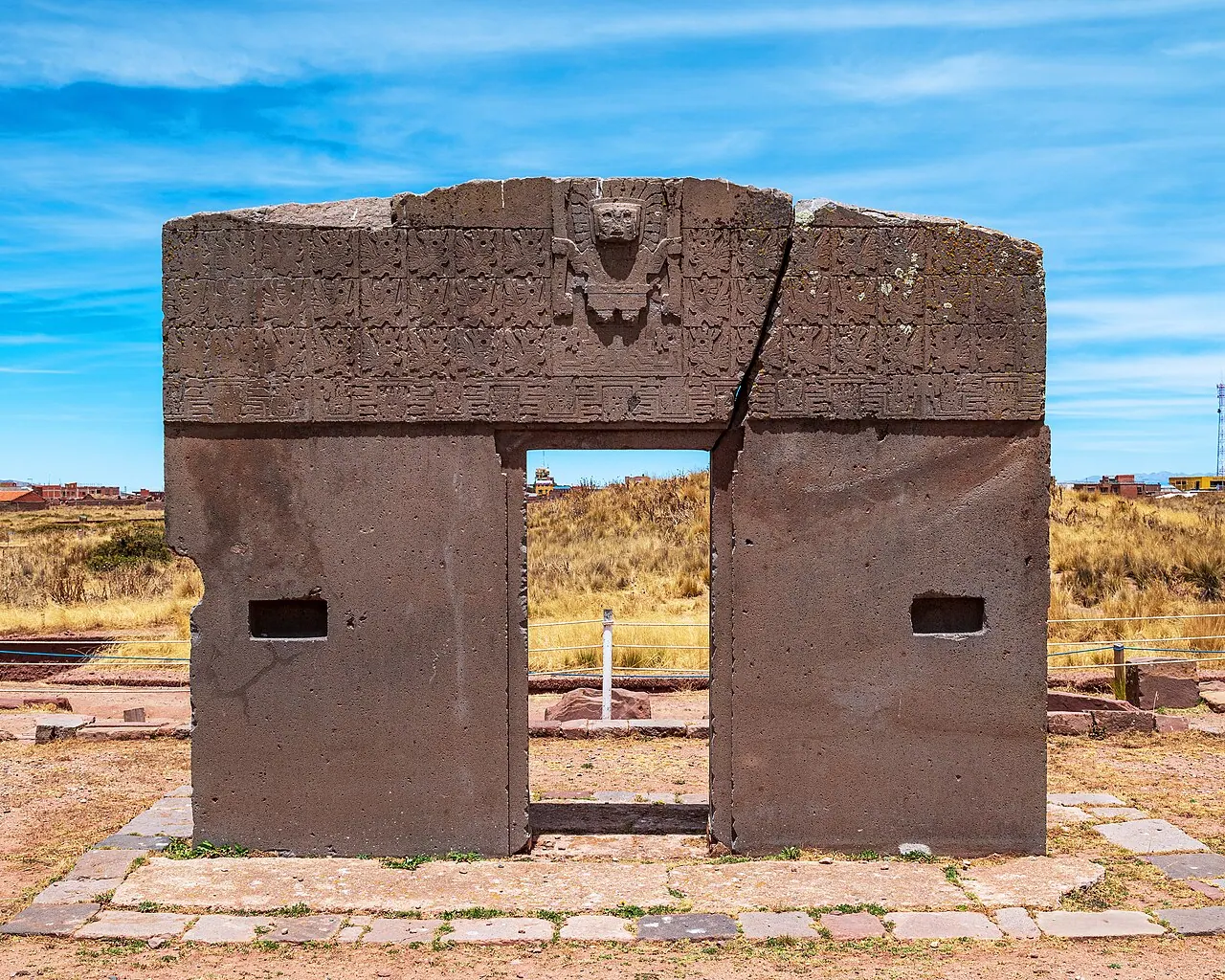
Near the shore of Lake Titicaca, Tiwanaku was the capital of a pre-Inca empire. Its satellite platform, Puma Punku, is strewn with andesite blocks cut into interlocking H-shapes with crisp inside corners, uniform drill holes and flat faces that flirt with machine tolerances. The Gateway of the Sun, carved from a single slab, bears a calendar frieze centred on the Staff God. Radiocarbon dates Puma Punku's first construction to ~536–600 CE, though alternative writers argue for vastly greater age.
See Tiwanaku & Puma Punku on the globe
Opens with the Sky Alignments lens on, so you can see what it connects to.
Notable facts
- Blocks were joined with poured copper-arsenic I-clamps — metal cast in place into carved sockets.
- The largest block, a red sandstone slab of about 131 tonnes, was hauled some 10 km from its quarry; the finer andesite pieces came from the Copacabana Peninsula, 90 km away across Lake Titicaca.
- Arthur Posnansky's 1920s archaeoastronomical dating of 15,000 BCE, though rejected, launched a century of alternative chronology.
Through the theories
How each theory reads Tiwanaku & Puma Punku. Follow a theory to see its verdict and every other site it claims.
Sky AlignmentsEstablished science
The Kalasasaya platform's corner pillars mark solstice sunrises; Posnansky's obliquity argument was built on them.
Sacred GeometryA spectrum
The modular, repeating H-blocks suggest standardised measure and template manufacture — proto-industrial geometry.
Lost WorldRejected by mainstream
Posnansky's 15,000 BCE archaeoastronomical dating made Tiwanaku the original 'antediluvian city' of the entire genre.
Earth GridNo measurable evidence
A fixture of 'ancient machining' literature; the drill holes and inside corners are its central evidence.
AstronautsNo physical evidence
Puma Punku's machine-crisp H-blocks are exhibit A in 'ancient machining' claims.