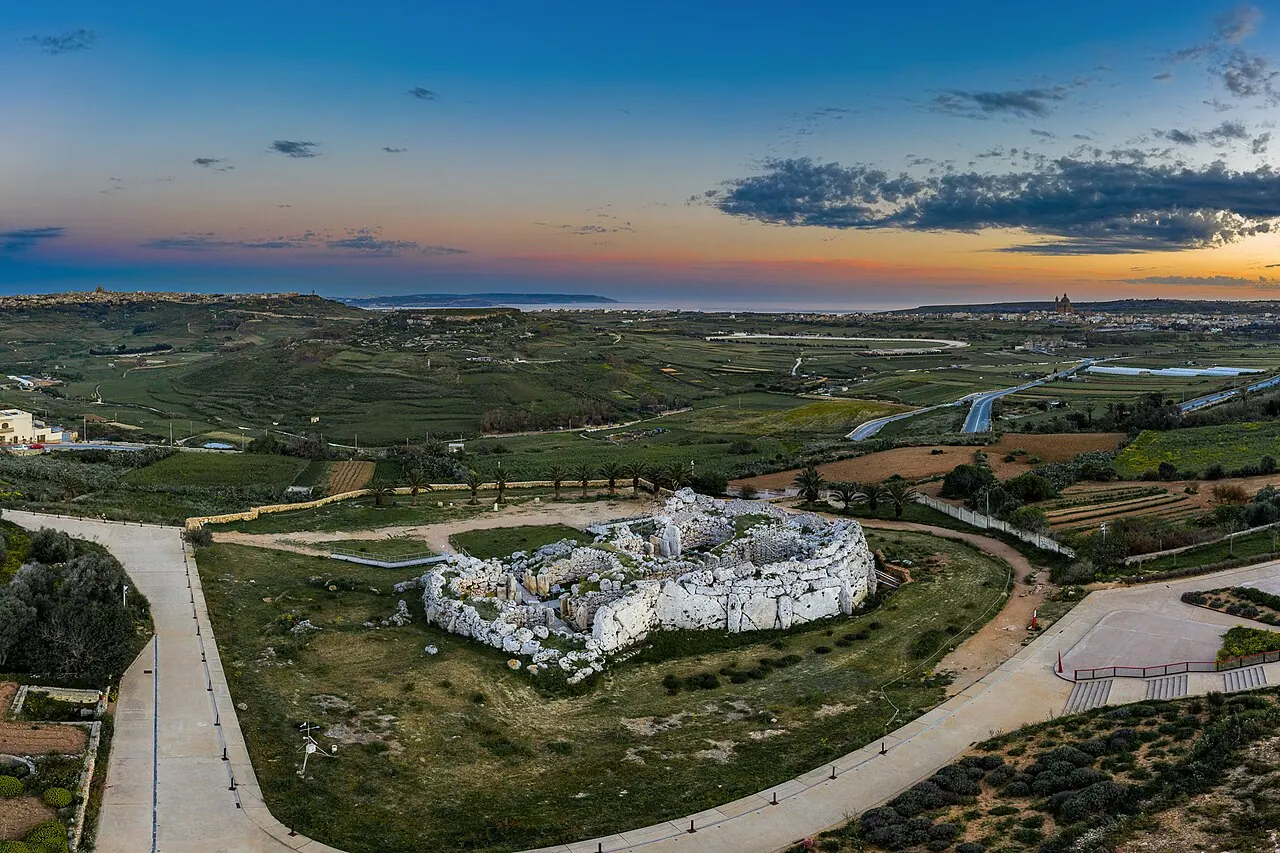
Malta's limestone temples precede Stonehenge and Giza. Ġgantija's walls, with blocks over 50 tonnes, still stand six metres high after 5,500 years. The temples' clover-leaf chambers, corbelled toward vanished roofs, held 'fat lady' figurines and oracle holes; at Mnajdra, the equinox sun fires straight down the main axis while solstice light clips engineered slit-images onto interior stones. Beneath, the Hypogeum of Ħal Saflieni — a subterranean temple-necropolis — has a chamber that resonates near 110 Hz, a frequency one small laboratory EEG study linked to shifts in brain activity.
See Ġgantija & the Malta Temples on the globe
Opens with the Sky Alignments lens on, so you can see what it connects to.
Notable facts
- Ġgantija (~3600 BCE) is older than Stonehenge and the pyramids of Egypt.
- The Hypogeum's 'Oracle Room' resonates near 110 Hz — a frequency that one small laboratory EEG study linked to shifts in prefrontal activity.
- Cart ruts ('Clapham Junction') scored deep into Maltese bedrock remain debated — their date and purpose are still unresolved.
Through the theories
How each theory reads Ġgantija & the Malta Temples. Follow a theory to see its verdict and every other site it claims.
Sky AlignmentsEstablished science
Mnajdra's equinox/solstice light events are precise enough to function as a stone calendar.
ResonanceMeasured; intent debated
The Hypogeum's Oracle Room resonates near 110 Hz — a frequency that a small laboratory EEG study (Cook, Pajot & Leuchter, 2008) found dampened language-area activity and shifted prefrontal activity rightward, which the authors tentatively linked to emotional processing.
Sacred GeometryA spectrum
Temple plans built from lobed circles suggest a rope-and-peg geometry tradition centuries before Egypt.
Earth GridNo measurable evidence
The Hypogeum's on-site acoustic measurements, paired with lab EEG work on the same frequency, make it one of the most cited 'resonant chamber' claims anywhere.