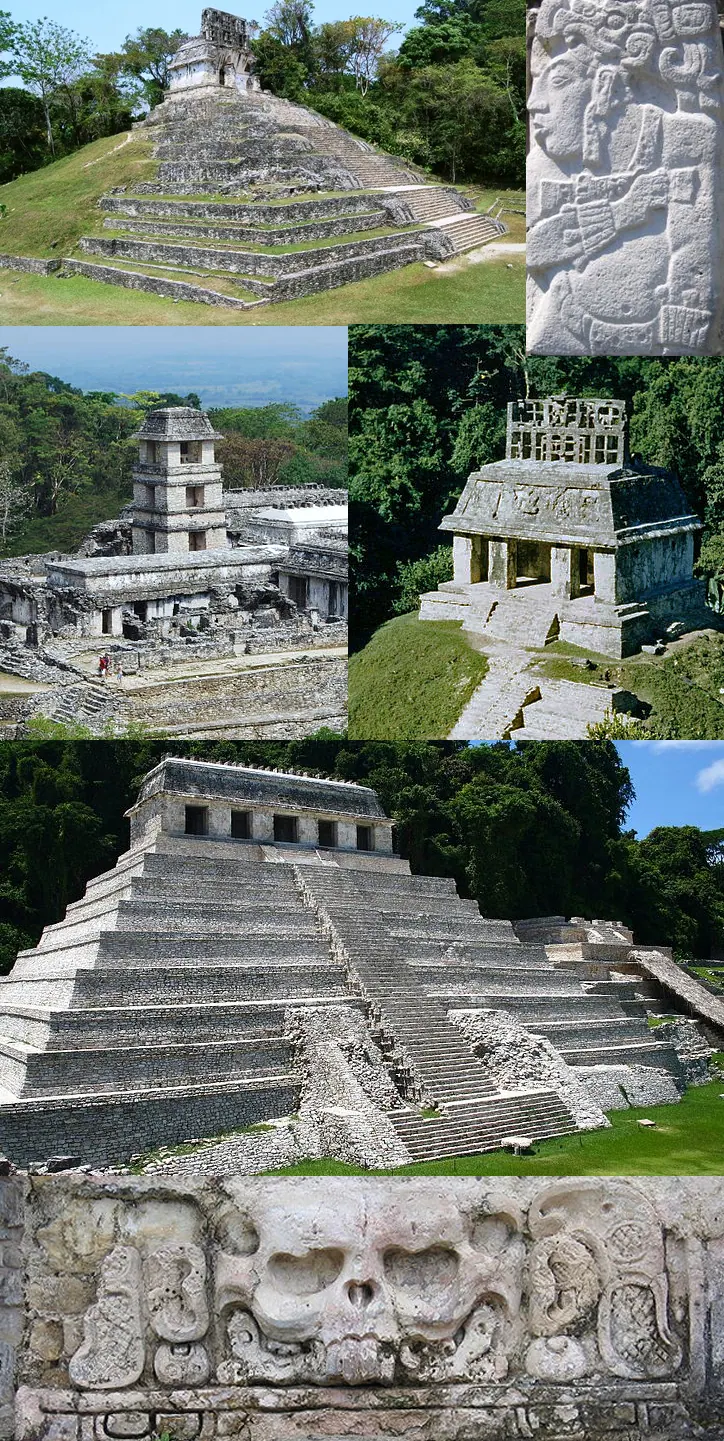
Palenque is Maya architecture at its most refined: mansard-roofed temples over a crystalline stream, inscriptions recording mythic time back 1.2 million years. Beneath the Temple of the Inscriptions lay the sarcophagus of K'inich Janaab' Pakal, its 5-tonne lid carved with the king descending into the maw of the underworld along the Milky Way — the image ancient-astronaut writers famously reinterpreted as a rocket cockpit.
See Palenque on the globe
Opens with the Sky Alignments lens on, so you can see what it connects to.
Notable facts
- Pakal reigned 68 years; when his tomb was sealed, a hollow stone duct — a 'psychoduct' — was left running from it up to the temple above.
- At winter solstice, seen from the Palace tower, the sun sets directly behind the Temple of the Inscriptions — as if entering Pakal's tomb.
- A narrowing conduit in the Piedras Bolas aqueduct appears to have been built to pressurise water — the earliest known engineered water pressure in the Americas.
Through the theories
How each theory reads Palenque. Follow a theory to see its verdict and every other site it claims.
Sky AlignmentsEstablished science
Solar hierophanies link the Cross Group temples in a triadic solstice conversation.
Earth GridNo measurable evidence
Von Däniken's reading of Pakal's lid in 'Chariots of the Gods' (1968) is the single most famous artifact of ancient-astronaut literature.
AstronautsNo physical evidence
Pakal's sarcophagus lid — a king falling into the world tree — became the most famous 'astronaut at his controls' in the literature.