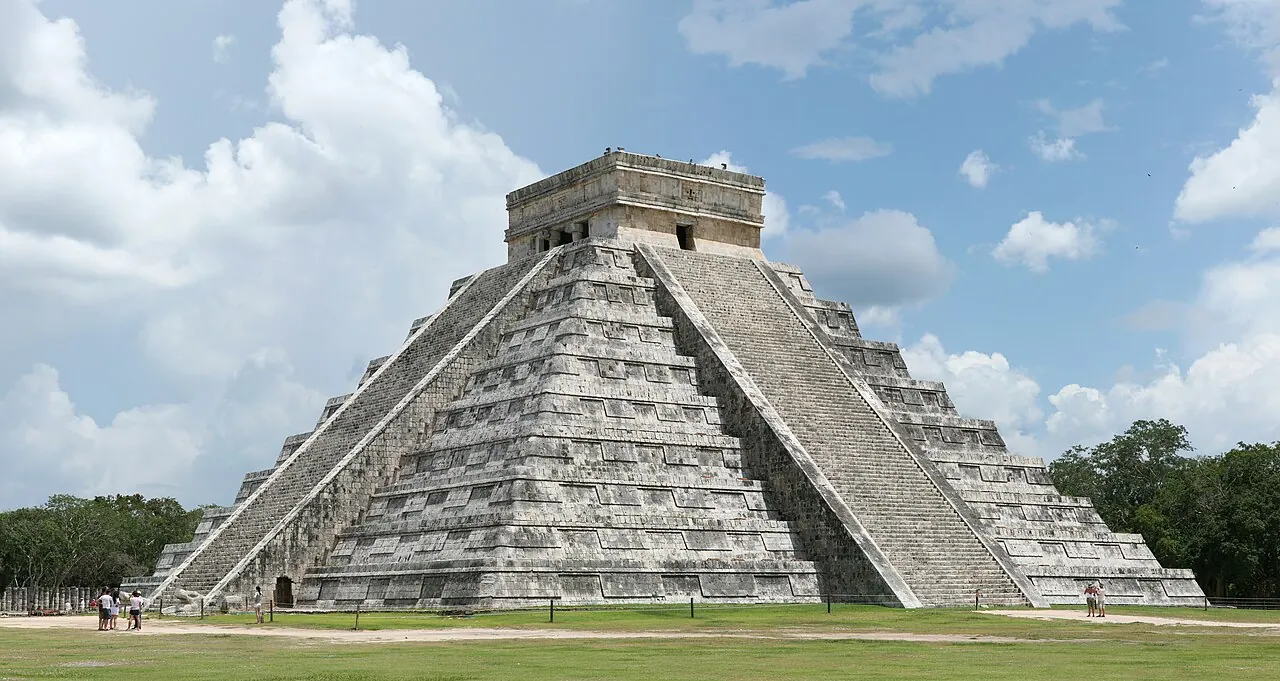
The great Maya-Toltec city of the northern Yucatán is dominated by the Temple of Kukulcán, a step pyramid that is itself a calendar: 91 steps on each of four sides plus the top platform total 365. At the equinoxes, the setting sun casts a diamond-back serpent of light along the north balustrade, joining the carved snake head at its base. Beneath the pyramid lies a cenote — a sacred well into the underworld.
See Chichén Itzá on the globe
Opens with the Sky Alignments lens on, so you can see what it connects to.
Notable facts
- A handclap at the base of the stairway returns a chirped echo resembling the call of the sacred quetzal bird.
- The pyramid sits above a natural cenote, discovered by geophysics in 2015 — a deliberate axis between sky and underworld.
- El Caracol, the round observatory, tracks the extreme positions of Venus.
Through the theories
How each theory reads Chichén Itzá. Follow a theory to see its verdict and every other site it claims.
Sky AlignmentsEstablished science
The equinox serpent hierophany and El Caracol's Venus sightlines are among the best-documented archaeoastronomy in the Americas.
ResonanceMeasured; intent debated
A handclap at El Castillo's stairway returns a chirped echo matching the call of the quetzal — argued by acoustician David Lubman to be a deliberately engineered effect.
Sacred GeometryA spectrum
The pyramid encodes the 365-day Haab calendar in stone, with nested platform geometry echoing the 52-year Calendar Round.
Earth GridNo measurable evidence
A favourite node in 'world grid' literature; its acoustics fuel speculation about engineered resonance.