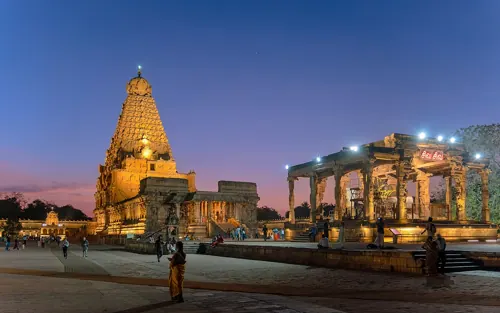
At the heart of the ruined Vijayanagara capital, the Vittala temple's great hall stands on clusters of slender granite columns that ring when struck. Local names group them as the SaReGaMa pillars, after the syllables of Indian solfège, and each is carved from a single block rather than assembled. In 2008 a team characterised eleven of the pillars without cutting into a single one, using low-frequency ultrasonics, impact-echo testing and in-situ metallography. The pitch matched what each solid column's dimensions and stone properties predict, which suggests the carvers were tuning as they cut.
See Vittala Temple, Hampi on the globe
Opens with the Resonance lens on, so you can see what it connects to.
Notable facts
- Traditionally fifty-six pillars, each hewn from one granite block and said to sound a different pitch.
- A 2008 study used ultrasonic and impact-echo testing to work out how, without damaging them.
- The stone chariot in the courtyard was built with wheels that once turned.
Through the theories
How each theory reads Vittala Temple, Hampi. Follow a theory to see its verdict and every other site it claims.
ResonanceMeasured; intent debated
The clearest case anywhere that a builder tuned architecture deliberately, and one of the few with instrumented measurement behind it.
Sacred GeometryA spectrum
Pitch follows each solid column's dimensions, so the carvers were working a ratio whether or not they wrote it down.