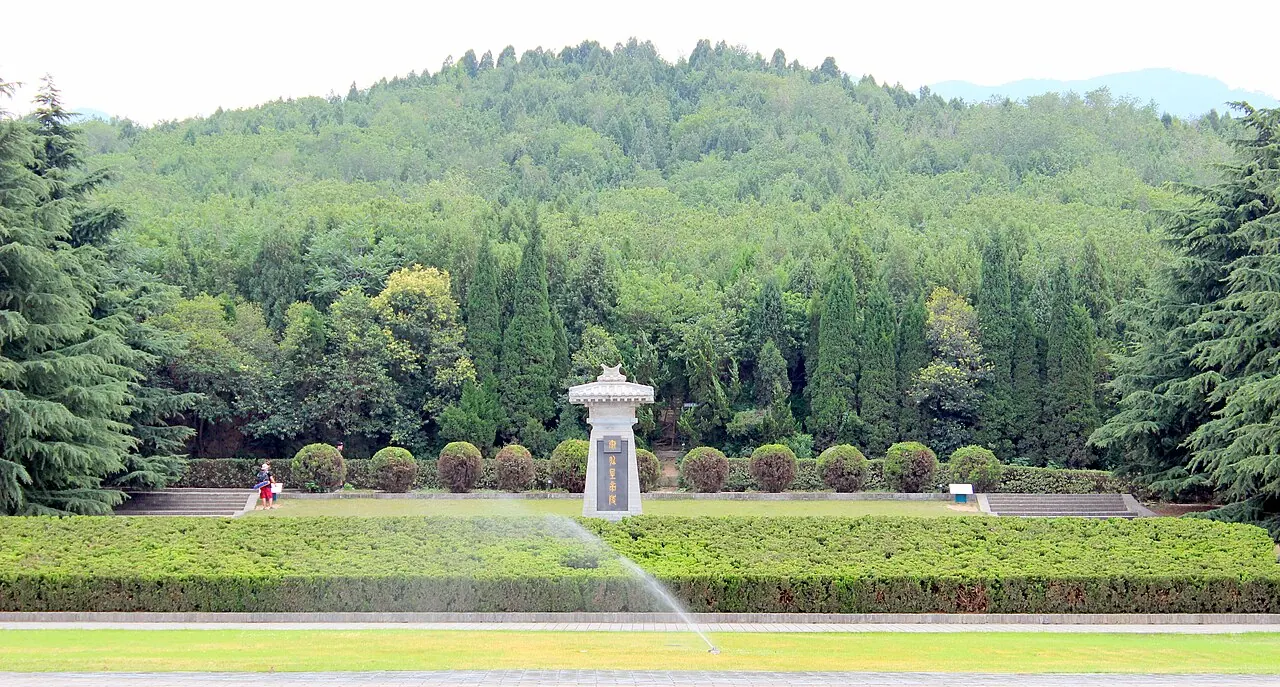
The Wei River plain around Xi'an holds dozens of monumental rammed-earth tomb mounds of Han emperors and nobles — flat-topped pyramids up to 47 metres, aligned with remarkable cardinality. The most famous, the unexcavated tomb of Qin Shi Huang, first emperor, is described by ancient historian Sima Qian as containing a model empire with rivers of mercury under a jewelled sky-map ceiling; soil tests show genuine mercury anomalies. WWII-era pilots' tales and a 1947 newspaper photo of a 'white pyramid' (later identified as Emperor Wu's tomb, Maoling) spawned decades of Western mystery literature about 'forbidden' Chinese pyramids.
See Xi'an Pyramid Mounds on the globe
Opens with the Sky Alignments lens on, so you can see what it connects to.
Notable facts
- Mercury soil anomalies over Qin Shi Huang's mound match Sima Qian's 'rivers of mercury' account.
- A 2018 satellite study by Giulio Magli found one group of Western Han mounds deviating a few degrees west of true north, and proposed they were aimed at a pole star — a hypothesis, not a consensus.
- The Terracotta Army — 8,000 figures — is merely the outer guard of the still-sealed tomb.
Through the theories
How each theory reads Xi'an Pyramid Mounds. Follow a theory to see its verdict and every other site it claims.
Sky AlignmentsEstablished science
Tomb alignments to cardinal points and possible pole-star shifts document Han imperial sky-mandate cosmology.
Earth GridNo measurable evidence
The 'Chinese pyramids' are a fixture of world-grid maps; the mercury rivers give them a genuinely strange centre.